


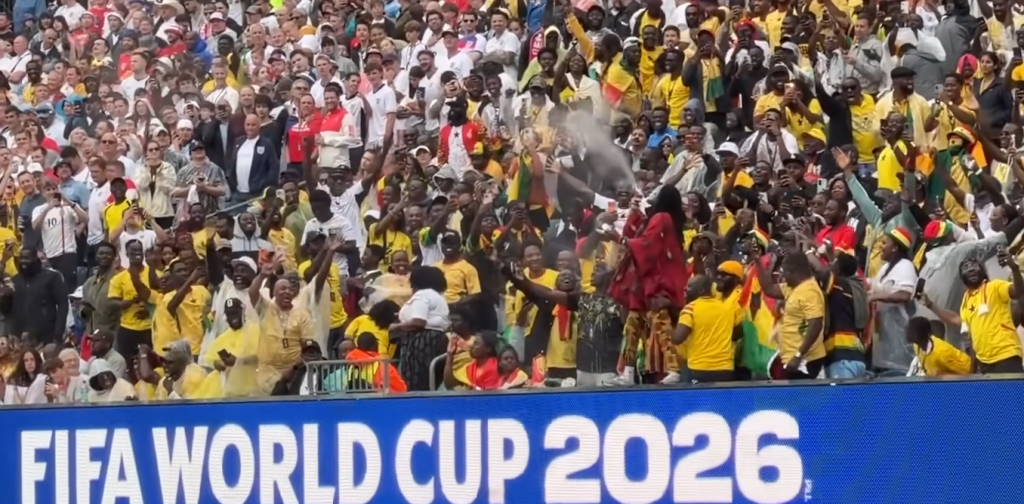

One of the most notable figures of the 2026 FIFA World Cup emerged during Ghana’s first match of the tournament: the “juju man,” Kailani Ibrahim Kpa, who was famously seen blowing white powder into the air during the game.
Another Ghanaian, Nana Kwaku Bonsam, went viral just before the match for claiming to have placed a curse on England’s captain, Harry Kane. Bonsam is a particularly media-savvy Twi traditional priest and one of the most recognizable faces of what is commonly called “witchcraft” or “juju” in African soccer.



Juju quickly became a topic of conversation and fascination for millions of soccer fans around the world, particularly after Kane failed to score and the match ended in a draw.
Although it may seem strange to westerners, soccer and esoteric rituals go hand in hand in Africa. One infamous video from Rwanda that regularly circulates on African group chats shows a striker failing to score, snatching a “charm” from inside the goal and subsequently scoring.
Ghanaians in particular have a long history of leveraging the spiritual side of sports. Former captain André Ayew scattered a ritual powder on the pitch in 2012, and Bonsam himself announced he cursed Portugal’s Cristiano Ronaldo ahead of the 2014 World Cup.
This blending of spirituality and sport can be easy for westerners to misinterpret or dismiss as simple superstition. This is particularly true when spiritual fraudsters try to make money by promising to help teams win and their predictions do not come true.
However, Africans are not backwards or simple-minded. Foreign academics and even colonial officials with first-hand experience with African spiritual arts have been surprised by how effective they are at achieving their intended results.
Fortunately, we also now have excellent written accounts from Africans about the power and logic behind Indigenous knowledge and ritual systems.
African knowledge systems
Western society has developed in a context that often seeks to define and establish separate religious and secular aspects of life. However, African knowledge systems generally treat what we might call science, religion, medicine and art as parts of a unified whole.
What westerners may call “religion” is often integrated into every aspect of African life, and it is more helpful to reconceptualize its relationship to sport as the reasonable engagement with the physical and metaphysical world toward a desired end.
When I studied with a priest and diviner in Nigeria, I helped him prepare many òògùn (a Yoruba term meaning simultaneously medicine, charm and technology) to heal and prevent injuries and harm.
Because all facets of their lives have a spiritual dimension, many Black and African players and teams regularly pray together before and after matches. Germany’s Jonathan Tah and Felix Nmecha made news by joining Curaçao’s team in prayer after their match.
From this perspective, a priest offering services to a team is just as legitimate as a sports psychologist, nutritionist or physiotherapist. Each draws on a long-standing tradition of experimentation, training and the application of different technologies to support favourable results.
For example, the Senegalese wrestling sport Laamb integrates marabouts (Muslim clerics) and amulets into competitions. The marabouts function much like boxing coaches, just also with power over immaterial forces.
Unlike in Laamb, spiritual intervention in soccer was not initially conceptualized as integral to the game, but it has, sometimes covertly, been integrated into the sport in Africa.
Accessing a nonphysical reality
A fundamental principle of Indigenous African spiritual systems is that all materials also have a nonphysical reality, and they can be used to effect change on that nonphysical level.
Powders, like those scattered by Ayew or Kpa seemed to blow, frequently contain dried, ground or burned natural substances with some characteristic related to the desired outcome.
These substances can be placed on or in a body, or important places such as a door frame or goal, to prevent things from entering. This is why the striker in the Rwandan example I mentioned removed the charm from his opponents’ goal while his opponents desperately tried to get it back.
Other common approaches include reciting incantations or soaking the body in ritual baths. Some also involve using flames to burn away or scatter dark and malevolent forces, like those I saw in a pot on the head of a Ghana fan at the 2010 World Cup.

Mischaracterization and prejudice
Europeans have often mischaracterized African ritual and knowledge systems as “black magic,” “witchcraft,” or “superstition” to justify a sense of religious, cultural and racial superiority over Black people. African religious practices and experts are also still frequently and pejoratively called “fetishism” and “witch doctors.”
The prejudice toward and dismissal of these practices and practitioners has driven many underground, but they are still ubiquitous in African society. Such pejorative attitudes were evident during Bonsam’s recent interviews in western media.
While I worked with the Nigerian diviner, people who might be considered “modern” and operating in secular spheres from a western perspective — such as university students, prominent business people and even politicians — regularly came for spiritual and professional help, which they understood as one and the same.
Athletes are particularly aware that talent and hard work are not always enough to ensure victory. Africans and non-Africans alike generally recognize that there are forces beyond their control at play, even if some might generically conceptualize those forces as “luck.” And even spiritual services are no guarantee of victory if the other side has access to them too.
It is unclear if Kpa’s powder was actually ritual material or simply a demonstration of cultural heritage, like Norway’s Viking row. However, after the goalless Ghana match, Kane did go on to score against Panama once Bonsam said he had “released” the Englishman.
Kpa and Bonsam unsurprisingly captivated African and non-African soccer fans, even if their actions may have been less legible to some. Beyond the World Cup, what may be more interesting is how both men represent an ancestral knowledge tradition that is thousands of years old, and they are merely a visible part of the invisible spiritual dimension of sport in Africa.














Comments are closed.