


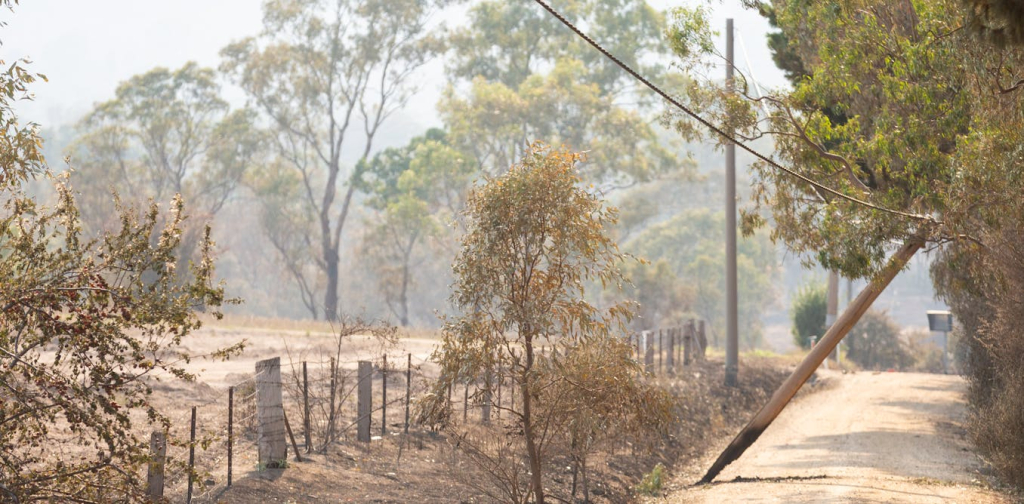

Australia has entered an era of climate instability, where communications during bushfires and extreme weather must perform under increasingly severe conditions.
Digital services such as the VicEmergency app and mobile fire alerts have become central to how people receive bushfire warnings. They work well in everyday conditions, but rely on mobile phone coverage and household electricity.


However, the communications networks that support these essential services have not been adequately strengthened. And older technologies, such as the copper landline network, have been removed or altered without their essential emergency function being fully replaced.
As a result, regional bushfire prone communities are more exposed when communications are critical. During last week’s Ravenswood fire, which devastated Harcourt and threatened neighbouring Castlemaine, this is exactly what happened.

Regional communications have been weakened
Two key changes in communications technology have altered how landline and mobile services can function during emergencies.
The National Broadband Network is replacing the old copper landline network. During a power outage, copper landlines still worked because electricity was supplied through the phone line itself. Of course, if a copper line was damaged by fire, the service would fail. But if lines remained intact, regional households could make calls during power blackouts.
In contrast, the NBN network relies entirely on mains electricity. Successive governments have chosen not to require universal battery backup for NBN connections. As a result, fixed line communication fails when electricity is lost, unless households have installed backup power at their own expense.
The shutdown of the 3G network in October 2024 has also reduced mobile coverage in some regional areas.
Retiring 3G services freed radio spectrum up for faster 4G and 5G networks. However, in practice, reports have identified growing mobile blackspots in locations that previously had coverage.
Significantly, warnings about these risks were raised before the shutdown. This included concerns that regional communities could be left without reliable communication during emergencies.

When the warnings went silent
The Ravenswood fire, which devastated Harcourt and threatened neighbouring Castlemaine, exemplifies this communications vulnerability in practice.
In Castlemaine on the afternoon of Friday January 9 2026, a power outage meant wifi routers and NBN connection devices stopped operating. This shifted residents onto mobile networks for calls, messages and internet access. For some, this overloaded the local mobile network, causing calls to fail and messages to delay.
As the fire progressed east, it destroyed the major telecommunications tower at Mount Alexander, temporarily interrupting emergency FM broadcasting across the wider region.
For a brief but critical period, some residents were left without access to official warnings, emergency apps or broadcast guidance. Those who had battery-powered radios as a backup, lost radio signal.
Modern networks a mystery
The 2020 Royal Commission made clear no single communication medium is immune from failure during a natural disaster. Emergency services also advise us to never rely on one form of communication for emergencies.
However, the recent changes to telecommunications systems mean many people no longer understand how contemporary communication networks operate, or how they can fail.
Both fixed line services and mobile phone services depend on complex infrastructure, including wifi, underground fibre optic cables and transmission towers. When a power outage occurs, they stop operating unless they have battery backup.
The sudden concentration of demand places heavy load on mobile infrastructure. The effect is similar to a digital traffic jam, with too many phones attempting to use limited network capacity at once.
The result is often a partial, rather than total, network failure. Phones may display signal bars, yet calls fail to connect. Text messages are delayed. Mobile data becomes slower and apps cannot update. For people relying on their phones for warnings and guidance, this degraded performance can be more confusing than a complete outage.
During the Ravenswood fire, this complexity became evident. Local community social media pages reflected widespread confusion. Some residents said they could not make calls or had very slow internet access. Others asked about the status of ABC broadcasting and when it would return.
Why ‘leave early’ is harder to enact
Bushfire preparation advice is designed to help people make decisions. Encouraging the public to plan ahead reduces uncertainty as conditions deteriorate and communication channels become unstable. On catastrophic fire days, the safest decision is made before a fire starts.
However, with entire regions all under the same catastrophic warning level, “leave early” advice can be difficult to interpret. It is not always clear where people should relocate, particularly when regional centres such as Castlemaine fall within warning zones. While many residents in central Victoria left in advance, others remained.
Research consistently shows disadvantage compounds disaster risk and reduces evacuation capacity. Lower income households, people with disabilities, and older adults often have fewer resources and support networks. This constrains their ability to evacuate safely.
Yet bushfire preparedness should not be left to individuals. Survival is a responsibility shared between individuals, government agencies, and industry. It should be supported by reliable infrastructure that enables the public to make informed decisions, both before disaster strikes and during an emergency.
New telecommunications technologies, such as the NBN and 5G mobile phones, deliver higher data capacity and greater everyday convenience. Yet they can be less fit for purpose when it comes to maintaining communications during emergencies.
A shared responsibility
These infrastructure changes have occurred alongside a shift in regional demographics and greater dependence on digital connectivity. Regional centres such as Castlemaine have experienced population growth in recent years. People are moving regionally for affordable housing and flexible work.
The burden then increasingly falls on individuals to bridge the gaps in degraded communications networks. Households are expected to pay for costly stop-gap measures, such as satellite services or battery backup for NBN connections. Responsibility for maintaining communications during emergencies is shifting from public systems to private households.
If we place greater emphasis on individual communications responsibility, the most vulnerable people face heightened risk. This compounds social and economic disadvantage. It also undermines the best contemporary approach to disaster preparation, which depends upon shared responsibility.
















Comments are closed.