


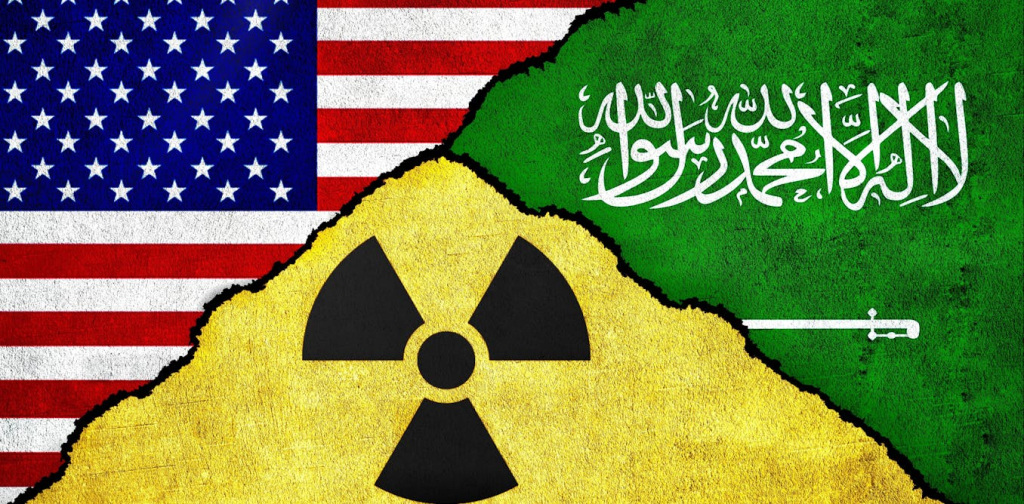

The US-Saudi nuclear deal was announced in the midst of what has, as of 2026, become America’s Third Gulf War. The news broke just as Saudi Arabia and the US launched air raids against Iranian-backed Iraqi militias, in retaliation for alleged drone attacks directed Saudi Arabia’s oil facilities.
The future details of a deal – which would allow for exports of US civilian nuclear technology to Saudi Arabia – remain uncertain. However, past events raise the question of whether Riyadh would ever use such a program to eventually develop nuclear weapons.


A range of historical factors have discouraged nuclear proliferation in Saudi Arabia, but this has changed over the last decade with the rise of two leaders: Saudi Crown Prince Muhammad bin Salman, who came to the throne in 2015, and US President Donald Trump – both in his first term from 2016 to 2020, and during his second term and ongoing war against Iran.
In 2010, I wrote a chapter entitled “Saudi Petro-Nukes? Riyadh’s Nuclear Intentions and Regime Survival Strategies”. In it, I argued that, historically, Saudi Arabia had signalled no interest in a civilian nuclear program, let alone the possibility of developing a nuclear weapons program. This was because of two major factors: US pressure, and Saudi Arabia’s position in the world economy.
US pressure
In 2003, on the eve of America’s war to eliminate Iraq’s alleged nuclear program, news emerged of Iran’s clandestine nuclear facilities. Policymakers presumed that the Islamic Republic’s program would spark a regional nuclear arms race, and that Saudi Arabia, its regional rival, would develop its own nuclear arsenal to deter Iran.
Saudi Arabia has long had the financial means to invest in a nuclear program, whether civilian or military. However, it lacked the domestic physical resources and scientific infrastructure to develop such weapons. It is also a signatory to the UN Non-Proliferation Treaty (NPT).
However, Saudi Arabia only signed the NPT after purchasing almost 50 CSS-2 missiles from China in 1988, when its previous request for a ballistic missile purchase from the United States had been rejected. Washington’s ire over the Chinese missiles led to US pressure for Riyadh to sign and ratify the NPT, and to never seek nuclear warheads for the missiles.
This precedent has informed Saudi decision-making since then, with the assumption that the same American stance would dissuade Riyadh from pursuing nuclear weapons in the future.
In any case, since the second world war, implicit American security guarantees to Riyadh offered a far safer and more robust deterrent to external aggression than a nuclear arsenal ever could. However, wavering US support for its allies in Europe mean those guarantees may not be as iron-clad as they once were.
Read more: What is the value of US security guarantees? Here’s what history shows
The economic factor
Saudi Arabia is a rentier petrostate dependent on oil revenues from a global market, and it is the world’s swing producer of oil as part of the Organization of Petroleum Exporting Countries (OPEC). This means it has economic relations with nearly every major world power, including the US, the EU, China, and Russia.
A Saudi nuclear program would have brought a volatile element into the equation that make it unattractive to the foreign investors that drove its growth.
This is in contrast to Iran, a country that, while also a petrostate, is more self-sufficient than Saudi Arabia. Iran has endured US sanctions since the 1979 Revolution, and the Iranian Revolutionary Guards (IRGC) has even found ways to benefit under sanctions. As of 2026, the IRGC are now the de facto ruling elite, and dominate Iran’s economy. Saudi Arabia’s ruling elite, by contrast, has always had a vested interest in stable, dependable international trade.
In the past, a Saudi nuclear program would only have threatened the Kingdom’s scrupulously internationalised economy, and its reputation for stability and pragmatism.
Muhammad bin Salman’s nuclear ambitions
While Saudi Arabia has historically had little need to pursue nuclear weapons, events over the last ten years suggest that this position could change.
The 2015 Iran nuclear deal signalled a US desire to coexist with Iran under the Obama administration. It was also the product of Saudi King Abdallah’s pragmatic regional policy. When Abdallah died in 2015, he was succeeded by Crown Prince Muhammad bin Salman – a very different leader who did not share his predecessor’s practical outlook.
The Crown Prince almost immediately intervened in Yemen’s civil war in 2015.
He also intensified the regional cold war with Iran. In March 2018, he publicly declared that Saudi Arabia would develop a nuclear bomb if Iran did. In November 2018, he announced a project to build the kingdom’s first nuclear research reactor.
In January 2019, revelations of a missile-making facility in Saudi Arabia served as evidence of a critical first step that Saudi Arabia was seeking nuclear weapons. While not relating to nuclear weapons themselves, the missiles would give Riyadh the capability to manufacture a long-range delivery system for nuclear warheads.
Read more: US-Saudi nuclear deal invites proliferation risks … unless safeguards are written in
In February 2019, the US Congress’s House Oversight and Reform Committee released a report alleging that members of the Trump administration sought to expedite the transfer of American nuclear technology to Saudi Arabia, a possible law violation.
The report has since been taken down, but the officials involved included General Michael Flynn, who briefly served as Trump’s national security adviser before being fired in February 2017, and Thomas Barrack, the chairman of Trump’s inauguration committee, who is now Trump’s envoy to Syria and Iraq.
Finally, in September 2019, two Saudi Aramco oil facilities, Abqaiq and Khurais, were attacked by a salvo of drones and cruise missiles, allegedly at the behest of Iran via militias in Iraq or Yemen. The Trump administration did nothing to prevent this attack, nor did it aid in any further punitive actions, leading Riyadh to question American security guarantees. The US withdrawing military support from its European partners will only deepen Saudi doubts.
All of this means that, in the aftermath of the 2026 war, Saudi Arabia will have a renewed interest in developing civilian – but not military – nuclear infrastructure as a latent deterrent against Iran.
Nevertheles, recent event show that such a program would not deter attacks by non-state actors – such as the Iraqi militias or Yemeni Houthis – that can attack the Kingdom. While these groups form part of Iran’s Axis of Resistance, they allow the Islamic Republic to claim a vitally important degree of plausible deniability.

A weekly e-mail in English featuring expertise from scholars and researchers. It provides an introduction to the diversity of research coming out of the continent and considers some of the key issues facing European countries. Get the newsletter!
















Comments are closed.