


Iran’s threat to target American warships with an enhanced ballistic missile appears to mark a new and potentially more dangerous phase of the Middle East conflict, six months in. Tehran says its solid-fuel Qassem Basir missile enables it to “take action against any threat, even before it is carried out”. Reports have suggested that the Qassem Basir was the missile used in tests Iran claimed to have carried out against US warships on September 5.
Washington acknowledged an Iranian attack on its nuclear-powered aircraft carrier USS George Washington and a guided-missile destroyer near the Strait of Hormuz. But it said it was unclear whether the new missile had been used and confirmed its vessels had evaded the attack. But the more assertive rhetoric coming out of the Islamic Republic suggests it is moving beyond the largely retaliatory strategy that characterised much of the war and is increasingly prepared to raise the stakes itself.


Tehran has also announced it is preparing to sign an agreement with Oman which would establish a new corridor through the Strait of Hormuz extending out into the Persian Gulf, although this has yet to be confirmed. Taken together, these developments suggest that Iran is no longer simply responding to escalation – it is increasingly trying to drive it.
This does not mean Iran has the upper hand militarily. Far from it. But Tehran appears to have concluded that prolonging and widening the conflict can improve its bargaining position by making the war increasingly expensive for the US and the rest of the world.
It’s an extraordinary reversal for a conflict intended to force Tehran’s hand and even possibly achieve regime change. Military superiority, while inflicting enormous damage on Iran, has not produced the political outcomes aimed at by the US and Israel.
The regime survives, its missiles continue to operate, the question of its nuclear programme remains unresolved, and its regional network retains offensive capabilities – something seen clearly in the latest attacks by Houthi rebels on Saudi Arabia. Meanwhile, the Strait of Hormuz has become a potent instrument of economic leverage for Tehran.
Never-ending cycle of confict
The war seems to have settled into a cycle: escalation, diplomacy, agreement, renewed coercion and then another return to diplomacy. Far from resolving anything, however, the six-month conflict looks to have taught Tehran that resisting US pressure eventually produces better terms.
The latest escalation suggests Iran is now exploiting that lesson. Tehran does not need to defeat the US navy or completely control the Strait of Hormuz. It needs only to make passage sufficiently dangerous that shipping companies hesitate, insurance premiums rise and energy markets price disruption into every barrel of oil.
Read more: Iran war has become a lesson in how power really works
Recent shipping data show commodity traffic through Hormuz falling to its lowest level since May. Tehran is now threatening wider restrictions on navigation and “economic warfare” if Washington continues trying to strangle the Iranian economy.
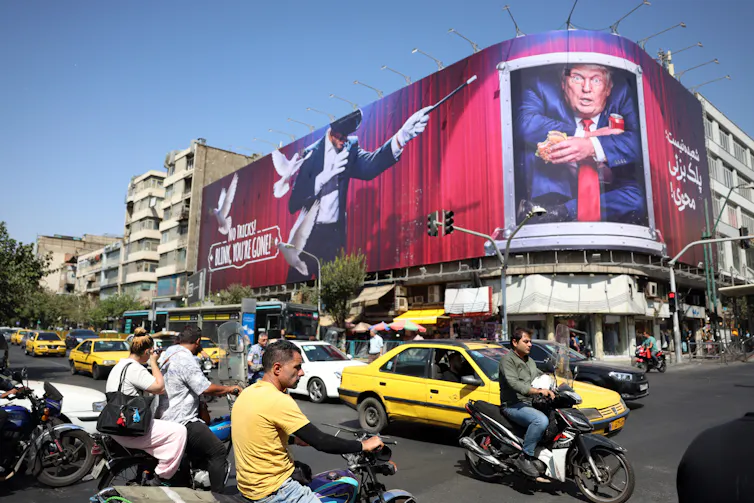
This changes the logic of the conflict. Trump sought to make Iranian resistance progressively more expensive. Iran is now making American coercion progressively more expensive too. It cannot match American firepower, but possesses something Washington cannot eliminate by force militarily: its geography and ability to control one of the world’s most important energy corridors.
The conflict should therefore be measured against its political objectives. The broader ambitions associated with the Trump-Netanyahu campaign were to fundamentally weaken or change Iran’s political system, eliminate its nuclear threat, destroy its long-range missile capability and break its network of regional allies.
Six months later, none of these objectives has been decisively achieved. The still-unresolved issue of Tehran’s nuclear ambitions particularly demonstrates the limits of military power. Bombs can destroy facilities, but not the political incentives that lead states to seek strategic deterrence.
Other regional powers are watching. Saudi Arabia has long sought domestic enrichment capabilities. If Middle Eastern governments conclude that a nuclear capacity provides protection against external attack, proliferation pressures could increase rather than diminish. Ultimately, the nuclear question returns to where it began: negotiation.
Trump’s escalation trap
Meanwhile the costs are becoming global. Energy, insurance and shipping costs have all risen and will surely have political ramifications. Meanwhile, Russia benefits from higher hydrocarbon revenues and China gains strategically whenever US naval assets, munitions and political attention are diverted from the Indo-Pacific.
Gulf states face an uncomfortable lesson too. US bases intended to guarantee their security can also make them targets in a conflict they did not start.
None of this means Iran is winning militarily. Its economy and infrastructure have suffered enormously – and America can still inflict far greater destruction. But Iran does not need to defeat the US. It needs to prevent Washington from using military superiority to force it into political submission while making continued armed conflict progressively more painful.
Trump is therefore caught in an escalation trap partly of his own making. He can tighten the blockade, but Iran can disrupt Hormuz. He can intensify bombing, but Tehran can widen its retaliation against Washington’s Gulf allies. He can negotiate, but Iran now has reason to demand stronger guarantees and potentially better terms than it accepted in June.
And US threats lose their coercive power when repeated escalation keeps bringing Washington back to negotiations.
The latest Iranian actions therefore represent more than another exchange of missiles. Six months after Trump and Netanyahu sought to force Iran into submission by force of arms, Tehran has learned that the longer it survives, the greater the costs it can impose and the stronger its eventual bargaining position may become.
America can still escalate far beyond anything Iran can match. What it can no longer assume is that escalation brings victory closer. Iran’s latest moves suggest Tehran now believes the opposite.





















Comments are closed.