


Canada has under-invested in rural communities for decades. Many analyses have delved into different aspects of rural neglect, including policy and planning at multiple scales. But a factor often overlooked is how much a funding program’s design drives where money actually goes — or doesn’t.
When it comes to accessing funding, rural communities face distinct challenges and disadvantages. For example, putting together all the information required for a government funding application requires capacity, which is often limited in rural communities.



Read more: In Canada’s 2025 federal election, is anyone paying attention to rural communities?
Funding programs open for any community to apply put rural communities in direct competition with urban ones — where capacity is higher and where the impact will be proportionately larger and therefore more attractive to funders.
Even in rural communities, success tends to build on itself, while setbacks can make it harder to recover. Over time, this means more money flows to places that are already doing well, while others are left further behind. The design of programs also often fails to reflect rural realities in terms of priorities, fundable activities and reporting metrics.
This issue is pervasive across the funding landscape and is currently worth consideration given the push for “nation-building” infrastructure projects.

Patterns of investment
Let’s take the example of public transit. Across Canada, public transit is a patchwork of unequal access — robust in some areas, virtually non-existent in others.
Rural and small communities are inequitably served and inequitably funded. Rural transit is on average more expensive, due to large distances, low population densities and fewer potential riders. Recent statistics indicate access to public transport in Canada is much lower in rural areas (11 per cent) as compared to urban areas (82 per cent).
Read more: Why rural Canadians need public transit just as urgently as suburbanites
While transit programs are often focused on urban places, it’s just as important for rural communities to maintain transportation links.
We examined whether federal transit funding has served rural Canada. It hasn’t. We also examined whether the Rural Transit Solutions Fund (RTSF) has successfully changed investment patterns to benefit rural communities. It has.
Our analysis covered five federal funding programs supporting more than 1,500 transit projects. What patterns of investment do we see? Geographically, that answer is simple.
In terms of the number of projects and total funds, Ontario dominates. Even when accounting for the province’s large population, our analysis showed substantial inequity:
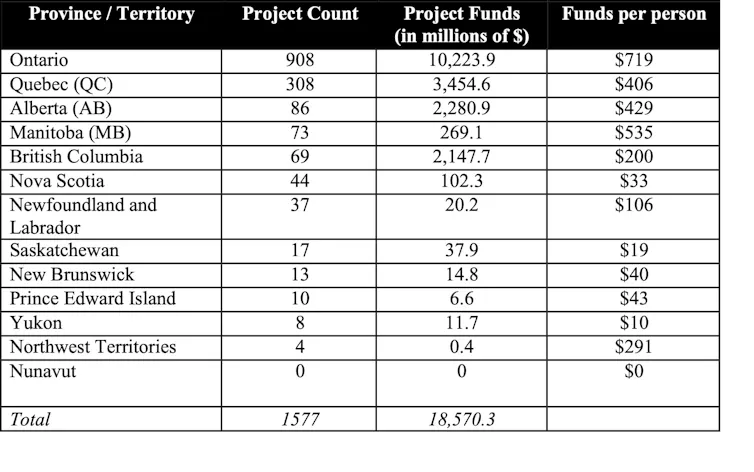
What about distribution by community size? All five funding programs were technically available to rural communities. But the reality of funding distribution illustrates an under-representation of rural and small communities — 69 per cent of projects serve large urban populations of more than 100,000 people, followed by 16 per cent serving medium-sized communities with populations between 30,000 and 99,999.
This mirrors findings of past studies illustrating under-representation of rural communities in government programming.
What about patterns in terms of what recipients receive the funding? By project count, local governments make up the largest group of recipients (74 per cent). Transportation authorities receive the largest portion of total funds awarded (52 per cent).
The RTSF’s success
The RTSF was established in 2019. It is a transit-specific funding program that targets rural and remote communities. Prior to the RTSF, there was no dedicated program or allocation for funding public transit in rural Canada.
Our analysis found the RTSF is changing patterns of federal investment. Building on the results of our previous study, we updated the analysis in 2025 to determine if those initial findings continued to hold true. Both original and updated results demonstrate the impact of program design on patterns of rural investment.
Consider geographic distribution. In terms of the RTSF, the primary recipient isn’t Ontario but Nova Scotia, with the largest number of projects, and Alberta with the highest funding total:
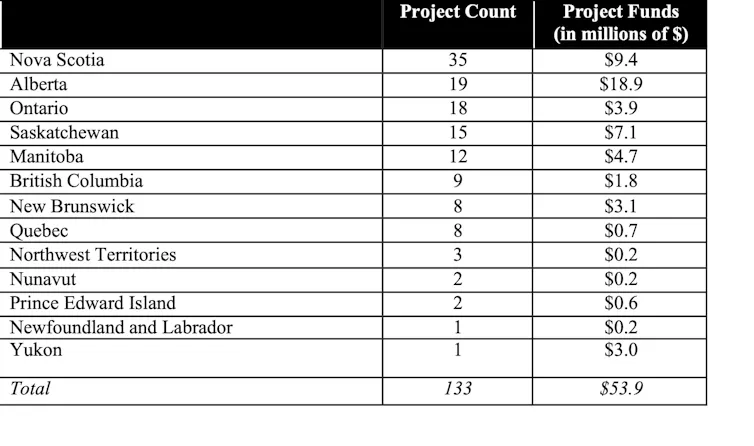
What about distribution by community size? Urban dominance held true across all funding programs, except for the RTSF. How the RTSF defines rural is flexible. Its goal is to serve rural and small communities, but it allows for applicants serving populations of up to 150,000 if they can demonstrate how their proposed project serves rural communities too.
Of the 133 RTSF projects in the updated analysis, 75 per cent serve small population centres of between 1,000 and 29,999 people. This is considerably larger than the 13 per cent of the projects funded by all other transit funding programs reviewed.
The largest recipient group by project number is still local governments, albeit to a smaller degree — 43 per cent.
First Nations, non-profits
A notable difference is funding of First Nations. The RTSF allocates a percentage of its funds specifically for Indigenous communities; it is the only transit funding program to identify First Nations as a primary funding recipient.
The updated analysis shows that First Nations make up 20 per cent of RTSF applicants.

There’s also been an increase in non-profit recipients — from 1.2 per cent in the overall analysis of transit funding programs to 33 per cent for the RTSF. Interestingly, this difference in funding recipients reflects rural reliance on non-profits and the precarity of rural transit services.
In terms of where funding is going, the RTSF demonstrates that a change in program design with allocated funds that explicitly target rural areas can dramatically impact patterns of investment. But issues still remain.
We found that the RTSF primarily supports the expansion of existing transit systems, with an emphasis on traditional bus transit systems, albeit with a predominance of on-demand bus routes. This presents two issues.
First, it indicates that those areas without existing transit systems are likely to continue to go unserved. Second, while the RTSF was intended to foster local solutions, it disproportionately prioritizes conventional transit — thereby overlooking innovative multi-modal approaches like car-sharing networks.
Another remaining issue is what’s eligible for funding, specifically the lack of consistent, predictable funding for ongoing operational costs, which research shows pose the most significant challenges to rural transit systems.
There is also a broader question about the scale of federal investment in rural transit. Perhaps counter-intuitively, rural systems require more investment, because they serve a smaller number of people over larger geographic areas.
That 15 urban projects in seven cities received more funding than the entire RTSF highlights the stark under-investment in Canada’s rural transit, severely limiting the program’s nationwide reach.
Considering the announced $3 billion per year for public transit and active transportation infrastructure, consideration should be given to ensuring that all rural communities can access funding — and that funding is allocated effectively on what is needed.





















Comments are closed.