



The changing of prime ministers, rather than marking epochs, has become rather commonplace. For the politically minded, that doesn’t mean that each is without the hovering of Tony Blair’s “hand of history”. A new premiership may last 49 days, or ten years. But a truly remarkable set of circumstances would be needed for Andy Burnham’s term to be fewer than three years. Labour is not a party to defenestrate its leaders. Keir Starmer achieved an unwanted first.
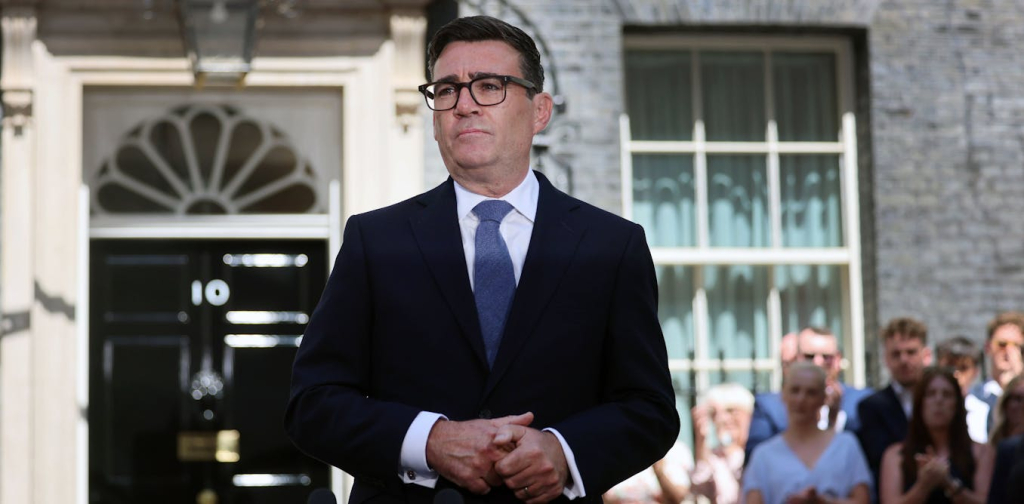
In Downing Street on Monday, a day of uncompromising sunshine and unrelenting news helicopters, several things were note-worthy. There was the lectern, or rather, its absence. The arrival of four feet of varnished wood has become the visual cliche of a turbulent decade in British politics. It was testament too to Burnham’s skill – and confidence – as a communicator that he doesn’t need one.



Read more: No lectern and the promise of a ‘new model’ – what we can learn from Andy Burnham’s speech
Then there was the silence. Incoming PMs do not name their ministers before they take office, but there had never been such little information. Burnham’s team kept its preparation watertight (early delivery on his promise of an end to a pernicious culture of briefing). The time it took to announce a cabinet, however, suggested friction.
Then there was the speech. Nothing new, but with a thematic coherence that betrays someone who has spent a long time thinking about it. There were political earworms. A “Number 10 in the North”, and “a more preventative state”. There was also a pledge from the curative state: the end of rough sleeping. Though there may have been the professing of “hope”, there was also the eschewing of references to spouses and children; an emotive hallmark of this political age.
There were the firsts. As prime minister Burnham is the first lifelong Catholic. The first of the Labour and Co-operative Party (a sister party of Labour). The first with a degree in English Literature (to listen to Starmer and Burnham is to hear the difference between studying law and studying verse).
There are also the firsts-for-a-while. The first prime minister from a north-west constituency since Harold Wilson; the first Cambridge alumnus prime minister since Stanley Baldwin in 1937.
There was the wait. This was Burnham’s third attempt to be Labour leader. Generally, politicians improve with age (up to a ceiling, though one rarely reached in modern British politics). Burnham first tried to become leader of the Labour party in 2010. He now has 16 years more experience and is, one might assume, a more capable politician. Devolution made him.
Making the cut
There was the hiring, and the firing. “The first essential for a prime minister,” said William Gladstone, prime minister four times in the 19th century, “is to be a good butcher”. There was concern that a politician so pleasant and pleasing as Burnham might also be somewhat squeamish. In the event, the blood stains in the Downing Street carpet may take some time to remove.
Former chancellor Rachel Reeves was reportedly offered a diminished cabinet role, and declined. But given the grounds for the change of regime, the change of regime needed to be seen. That meant not only a new prime minister, but a new deputy prime minister and chancellor.
The choice of John Healey neatly neutralises two key issues for the government: defence spending (Healey resigned from Starmer’s government over this issue), and the markets (Healey is not Ed Miliband). The likely consequence of an increase in defence spending will have been welcomed both by Nato partners and Ukraine’s beleaguered people.

Miliband’s promotion to foreign secretary indicates that, not for the first time, most plum jobs have been used as a consolation prize. Such generosity matters less when a prime minster is their own foreign secretary (a trend broken recently only by Rishi Sunak who outsourced foreign policy to David Cameron). But Burnham is avowedly a domestic “cost-of-living” premier. As chancellor Miliband would have threatened to dominate domestic politics; he will now mostly be out of the country.
Pat McFadden continuing as work and pensions secretary may pique the left with his aversion to inflated welfare spending, though it will reassure more. In contrast, Yvette Cooper’s dizzying collection of cabinet posts – health is her fifth – does little to slow the churn in British politics.
The “vibes PM” started suitably enough: capping bus fares, removing VAT from electricity bills, flirting with raising tax thresholds; popping up in Bath to show that he knows where it is. He also had his first day at Number 10 North, in Manchester.
The prime minister attended the opening of the Commonwealth Games in Glasgow, taking the opportunity to meet the Scottish first minister and deny him another independence referendum. Burnham’s deeply felt devolution feels to some an English affair. He may need to show some love to the Council of the Nations and Regions.
Finally, there is the weight. Expectations are much greater for Burnham than they were for Starmer: two years in office are felt to have been wasted, at least in part. A Reform UK government may be two years nearer. Burnham himself has said that Labour will get no second chances. He also meant the country.
In Downing Street on Monday evening, the scaffolding that now runs the length of the street on “prime minister day” was dismantled. It had last been used only two years ago.
Burnham will not want to hear it going up again for three years: at the time of his general election announcement. Nor will he want to hear the applause and whoops that accompany an evicted prime minister as they trudge down the street with their spouse – that most hypocritical and aural cliche of a turbulent decade in British politics.




















Comments are closed.