


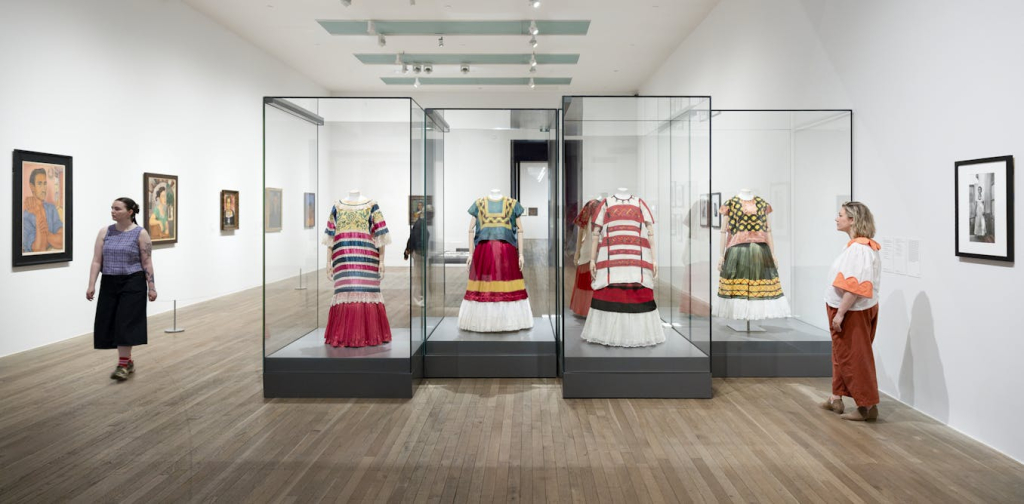

Frida: The Making of an Icon at Tate Modern is the first major interrogation of the Mexican painter Frida Kahlo’s legacy in London for 25 years. It already has more advance sales than any exhibition in Tate history.
The title puts the visitor on first name terms with someone who died in 1954. Yet despite the many privileged glimpses into Kahlo’s life, from photographs, to objects, and – of course – her work, the show is more about ubiquity than intimacy.


The opening sections of the show are brilliant. Immediately to the left of the entrance are two photographs taken by Kahlo’s father when the painter was 18. In one, she is seated in ¾ profile, wearing a dress and holding a book, if not withdrawn, thoughtful. In the other she is pictured with her sisters and their cousins. She stands, slightly taller, in the centre, dressed in one of her father’s suits, one hand in her pocket. She stares out of the picture, with an outwardly directed intensity.
The photographs were taken just months after Kahlo was involved in a bus accident that resulted in a life of periodic surgery. This trauma, among others, is a motif in her work. The seated Kahlo tucks her damaged right leg behind the other; the standing Kahlo holds a walking stick in her right hand. These two images contain the promise of the show: suffering, introversion, defiance, self-presentation, representation and our understanding of these acts today.
Here there are several self-portraits that chart the development of Kahlo’s artistic voice. Her first, Self-Portrait (in a Velvet Dress) (1926) shows a debt to European influence, a synthesis of Italian Mannerism and Art Nouveau. Much more direct and disturbing is the charismatic Self-Portrait with Loose Hair (1947). The background is a slab of the volcanic rock of her homeland. This has the effect of dramatically compressing the implicit space between the image and the viewer: it’s a powerfully psychological presentation of her own creation.
But Frida: The Making of an Icon is not really an exhibition of Kahlo’s work. It is a cataloguing of her legacy. There are only 30 or so works by the artist herself, but very many more by her contemporaries and her successors. It is rich and rewarding to see her work in the context of her Mexican contemporaries, among them Olga Costa and the melancholy Manuel Rodríguez Lozano. It helps to ground Kahlo’s work, showing it, as it were, in its first moment.
Read more: How Tate Modern is serving up Frida Kahlo – from canvas to cuisine
There is a similarly rewarding collection of her Surrealist contemporaries: the sparkling canvas by Jacqueline Lamba, Untitled (For Frida) of 1944 is a joy.
As the show demonstrates, Kahlo’s work has been adopted by an astonishingly heterodox group of marginalised people. She is a symbol of the power of self-invention on one’s own terms, even – or especially – in adversity.
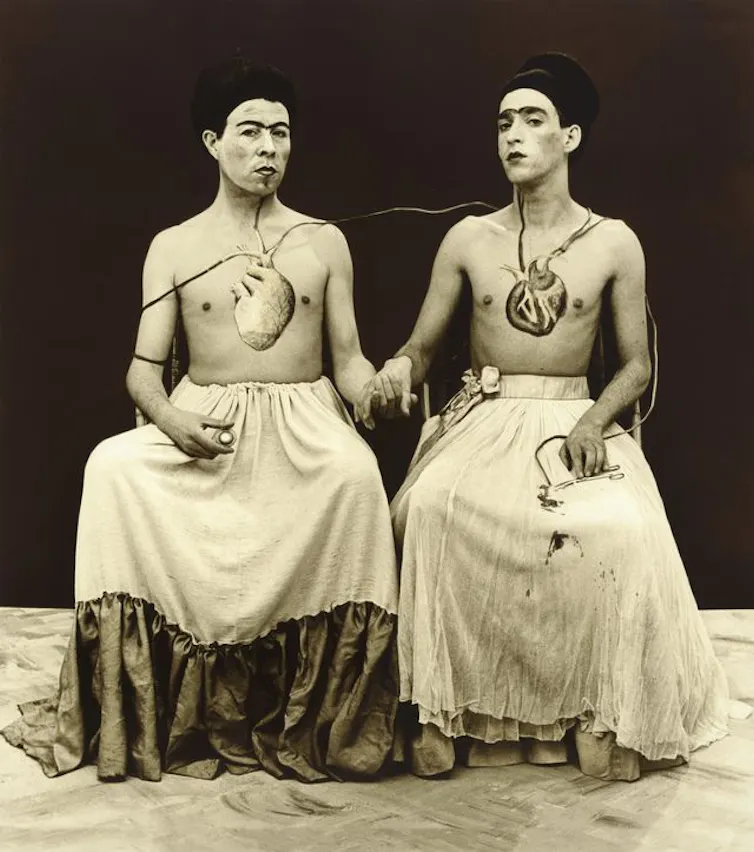
Later sections are given to her influence on art and activism, from feminist, to queer and disabled practice. By showing Kahlo alongside artists like Berenice Olmedo, whose work uses prosthetics to reframe the human as “an open process of self-construction”, as Olmedo puts it in the catalogue, or Martine Gutierrez’s exploration of trans identity, or Las Yeguas del Apocalipsis, whose 1989 restaging of Kahlo’s Las dos Fridas exercised queer visibility at the height of the Aids epidemic, the curators show how salient Kahlo’s example is to other artists – artists whose work might otherwise not be seen by a gallery-going public.
Agency and the afterlife
The development of bodily and artistic autonomy is a thread running through the show. But it is not uncomplicated. Even in the first part of the exhibition, there’s a sequence of photographs by her friend, the dealer Julien Levy, that strike an off-note. These expose Kahlo naked from the waist up, un-tressing her hair. The photographs feel voyeuristic, strikingly not self-composed, vulnerable and not on her own terms. She appears to have little agency here – she has either given it to him, or he’s taken it from her.
As I made my way through the later, post-mortem parts of the exhibition, given over to documenting the many homages, quotations and reinterpretations of her work, my mind came back to these photographs.
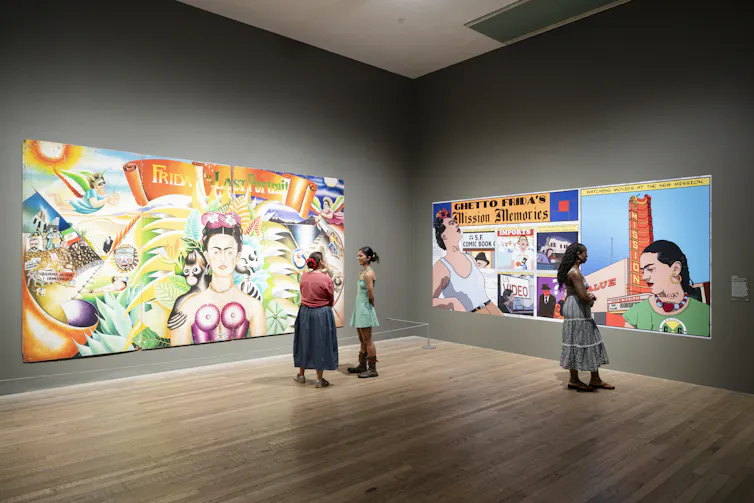
With laudable scholarly thoroughness, the curators map the many empowering gifts that Kahlo’s legacy provides. But there is another side to this exchange. Toward the end of the show, I felt that Kahlo was not being honoured, but bleached. Post-mortem, what agency can Kahlo exercise, as her image is endlessly remade?
Artistic legacies are always collaborative. The work an artist leaves behind is kept vital through reinterpretation, critical study, homage, collection and display. There are few artists who have given the world such a recognisable image and such an open proposition. It is now more than 70 years since Kahlo’s death, and the show’s centre of gravity is not in Kahlo’s work – but rather in what happened next.
As the visitor moves toward the final room, a display of folk art adoptions of her image and somewhat tasteless merch, they are primed to exercise their wallet in the gift shop. The show fulfils its stated purpose, mapping the artist’s evolution from person, to icon, to global brand. By the end, her image is fully detached from her person – a hollow sign into which we might read anything we want.
Frida: The Making of an Icon is at Tate Modern from June 25 to January 3 2027




![jelajah-meratus:-berkunjung-ke-juhu,-desa-surga-flora-fauna-[2]](https://kabarwarga.com/wp-content/uploads/2026/09/63501-jelajah-meratus-berkunjung-ke-juhu-desa-surga-flora-fauna-2-570x285.jpg)





![jelajah-meratus:-berkunjung-ke-juhu,-desa-surga-flora-fauna-[2]](https://kabarwarga.com/wp-content/uploads/2026/09/63501-jelajah-meratus-berkunjung-ke-juhu-desa-surga-flora-fauna-2-150x150.jpg)



Comments are closed.