



Warning: this article contains spoilers for Christopher Nolan’s The Odyssey.
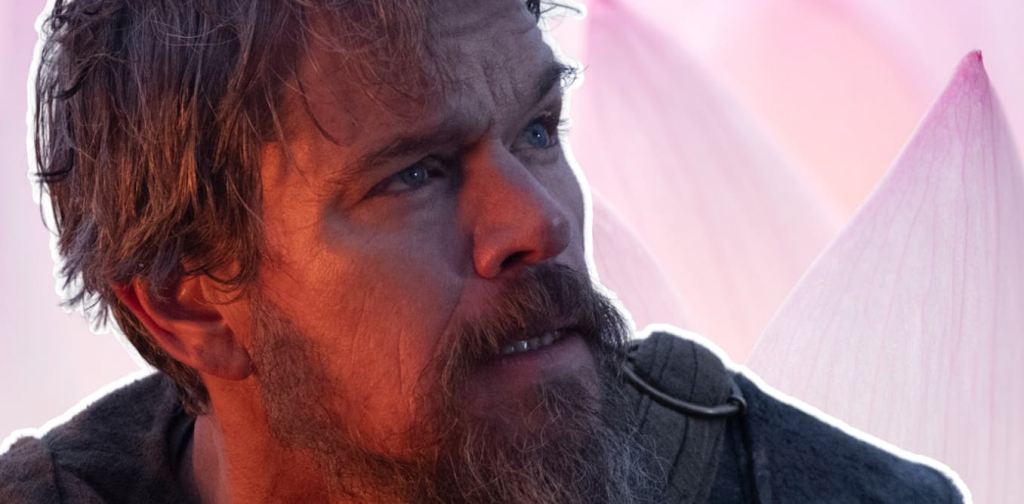
In Christopher Nolan’s The Odyssey, Odysseus (played by Matt Damon) is lost not only at sea, but within his own memories. On the island of the nymph Calypso (Charlize Theron), eating lotus flowers offers him relief from the trauma of Troy, allowing him to forget the war, his comrades – and eventually even his wife and son.



While it’s a point of focus in Nolan’s film, the episode of the so-called “Lotus eaters” is, in the scheme of Homer’s Odyssey, very minor. Occupying scarcely more than 20 lines of verse in a poem of over 12,000, the story of the magical, memory-wiping fruit is no more than an unfortunate escapade.
The cyclops, in the economy of the poem, is far more significant. The famous trick, by which Odysseus makes the cyclops believe he is called “Nobody”, rendering the creature’s cries for help useless (“Nobody is attacking me!”), encourages Odysseus, at a safe distance, to reveal his name. The cyclops’ subsequent curse becomes a major motive force for the rest of the poem.
Christopher Nolan’s new film adaptation of the Odyssey has reversed this. Although the cyclops still represents the clash of civilisation and brutishness, the episode in the film is relegated to a symptom of a wider problem.
When finally reunited with his wife, Penelope (Anne Hathaway), Odysseus confesses his guilt over the destruction of Troy. To trick a people into accepting a gift – the Trojan horse – which spells their doom, in the name of the goddess Athena, is to violate the divine sanctions that keep human behaviour decent. If the cyclops does not know “the laws of Zeus” (in Greek, xenia: the bonds of behaviour between guest and host), what of it? The Trojan war has collapsed any meaning these notions once had anyway.
Into the gap steps the lotus – in Nolan’s film it’s a flower, and not a fruit as in Homer’s poem. In Nolan’s film, the magic flower is used by Calypso to purge Odysseus’ trauma. What she unleashes is, however, a crippling addiction. Only through painstaking narrative can Odysseus slowly piece together the memory of his men, and only by touching an artefact from his past can his memory of his wife be restored. The whole first half of the film, then, is a lotus-induced dream.
The traumatic Odyssey
How are we to handle memories we do not like? If you could remove them, would you? For many, memories are so painful that chemical remedies are sought.
Among UK veterans of combat, 11% have reported alcohol misuse problems. In the US, some million veterans suffer from addictions to alcohol or drugs.
Nolan’s Odysseus is a commentary on this. Confronted with a world he has played a pivotal role in destroying, Odysseus loses himself in lotus addiction. Calypso’s motives are left tantalisingly ambiguous. Part nursemaid, part temptress (but somewhat sexless in comparison with Homer’s version), she regulates the supply of the drug she has introduced him to (we see her both encourage and forbid the use of lotus).
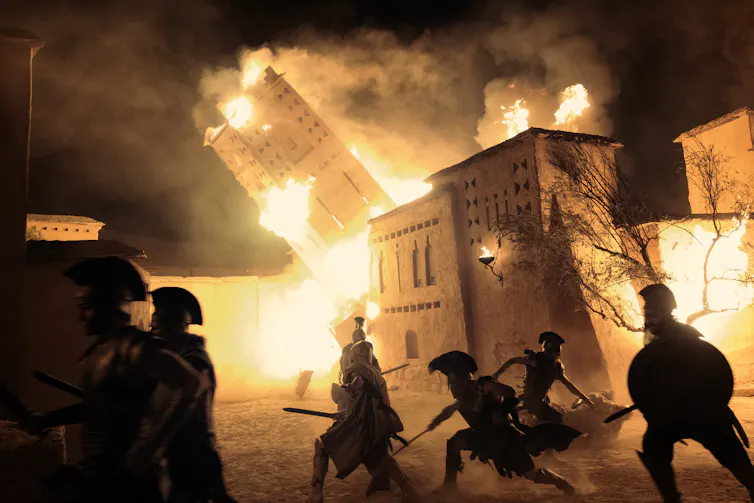
Both forgetting and memory have their pitfalls. Neither the bitterness of dwelling on a lost past, nor the blanking out of suffering, are the same as healing. In Homer’s Odyssey, a pivotal moment features Odysseus listening to a singer tell the story of the Trojan war at a banquet. It’s the only time Homer actually mentions the notorious wooden horse. Much is made of Odysseus’ response: he covers his face and he weeps. The song of the Sirens too introduces Odysseus to pain and regret, to memory both lost and betrayed.
In the film, unlike the poem, narrative therapy – the telling of the tale – does not suffice. The solution is rather the rediscovery of powerlessness – of a small human’s place in a vast world. Nolan’s Odysseus is a figure of controlling power, whether successfully, in the case of the attack on the Cyclops, or unsuccessfully, as Circe (Samantha Morton) implies when his men raid her home. Research has found that surf therapy can help veterans suffering with PTSD. In a similar way, Odysseus’s trauma is healed by understanding, and yielding to, what he cannot control after all.
Odysseus is described by Homer in the first line of the poem as polutropos: “of many turns”, “complicated”, “resourceful” – the word is notoriously untranslatable. Whatever this means, in Nolan’s imagination, Odysseus is not a warrior. He is a culture hero – a figure who changes the world – and it is responsibility for the downfall of a culture which has marked him with trauma.
This article features references to books that have been included for editorial reasons, and may contain links to bookshop.org. If you click on one of the links and go on to buy something, The Conversation UK may earn a commission.





















Comments are closed.