



For centuries, the image of the ancient Egyptian princess has been shaped by ideas of ceremony, beauty and royal privilege. But a new scientific study suggests that some princesses of the Middle Kingdom (2030–1650BC) were highly trained, physically capable women who may have mastered weapons such as bows and maces. Their story challenges the assumption that women in the ancient world were largely observers of power, rather than participants in it.
New scientific analysis published in Frontiers in Environmental Archaeology has shed light on the activities of these royal women. It has found evidence of a group of princesses who were practised archers.



While the skeletal markers could indicate practice in other activities, the inclusion of the archery equipment in particular strongly suggests they used it frequently. The findings highlight the need to revisit ideas of gender roles in the ancient world.
Far from being passive supporters of men as the leaders of ancient Egypt, women played a crucial role in all aspects of the development and continuity of the state. Some even ruled the country in their own right.
The scientific study focused on six royal mummies, discovered in the late 19th century at the site of Dahshur, a royal necropolis on the west bank of the Nile, about 30km south of Cairo. Of the group, four were daughters of King Amenemhat II (19th century BC). Only four names belonging to the women have been recovered from the burial: Ita, Itaweret, Sathathormeryt and Khenmet. The sixth set of remains belonged to King Hor, who ruled around 1750BC.

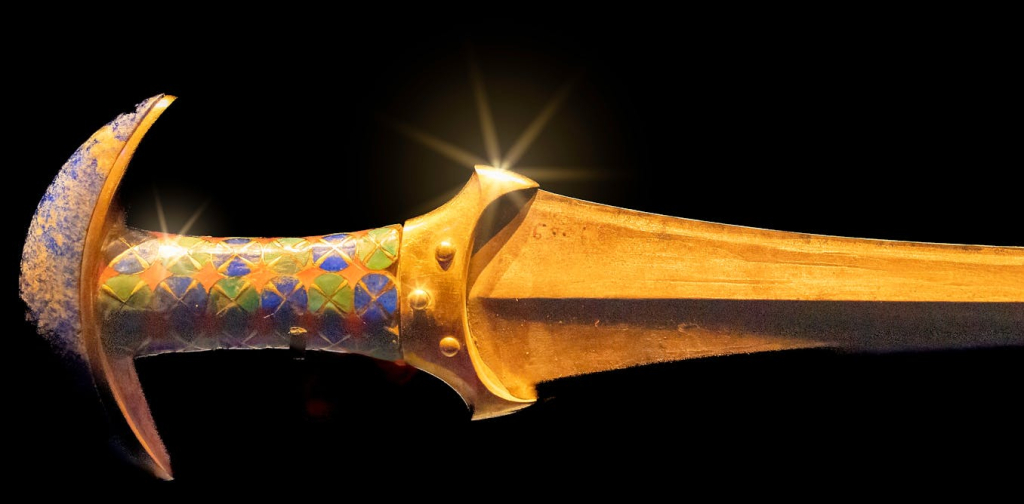
The grave goods buried with these women included bows, arrows, maces and daggers. The study examined whether these weapons were placed in the burial for symbolic or ceremonial reasons such as protection for the afterlife, or statements of wealth – or whether they had actually been used in life.
The princesses’ skeletal remains – although incomplete – showed a high level of physical fitness, especially in the upper body. They had robust muscle attachments that indicated habitual, repetitive movements consistent with the practice of archery. The use of other weapons such as swords and maces was also indicated.
While the context for these activities is not yet clear (for example, if the women took part in battles or hunts) other skeletal damage confirms that the princesses led a very active lifestyle.
They had sustained injuries consistent with falls or blows. Their injuries were well-healed; as royals, they would have had access to the best medical attention and they were eventually buried with their weapons as intimately personal possessions. These were symbolic of their status and intended for protection in the afterlife, but also reflected what these women actually did.
Reassessing gender roles in the ancient world
The history of archaeology is peppered with assumptions about what women were capable of. Archaeological interpretation is a product of its time, a reflection of our own society’s values. Modern archaeology strives to recognise these circumstances and reviews the evidence, to present our current best theories without dismissing the approaches that came before.
The nature of ancient Egyptian art can be misleading. The representation of women in tombs, on walls, in temples, implies that they are less present in the power structure of ancient Egypt. But Egyptian art was designed to convey concepts, not reality. We are looking at a highly complex set of ideas, refined over centuries and we cannot practically use it on its own as evidence for ancient lives.

Certain key female figures in ancient Egypt stand out, of course – few people have not heard of Hatshepsut, Nefertiti and Cleopatra VII – but they are not anomalies. Alongside their achievements are the likes of Sobekhotep, female king; Ahhotep, a king’s mother who was awarded military honours; and Nebet, grandmother of king Pepi II and holder of the highest office in Egypt other than the king.
While such honours often come with having royal blood, they are a reminder that the princesses at Dahshur are not outliers, but active, accomplished people in their own right.
Recently, a comprehensive database of ancient Egyptian women has been launched, detailing names, titles, textual mentions and more, showing that there is still much work to be done in this area. The team studying the Dahshur princesses will continue and they are optimistic that further scientific analysis will yield more details of their lives.
The topic of “warrior women” goes beyond ancient Egypt; many disciplines face the same question: how often have we misunderstood gender roles in the past? Historically, the inclusion of traditionally “male” objects like weapons and horse-riding equipment, and “female” objects such as jewellery and cosmetics, has led to assumptions about not only the sex of the person to whom they belonged, but their roles and occupations in life.
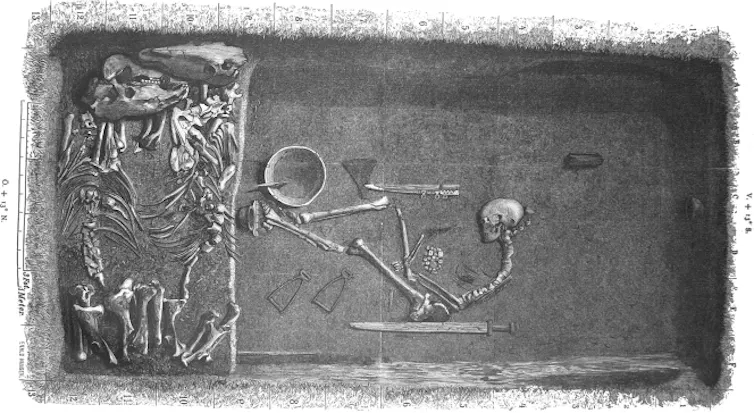
Recent cases include the reassessment of the Grave Bj 581, the final resting place of a warrior in 10th century Birka – a historical Viking trading post in Sweden. It was thought for over a century to be a man on account of the weapons interred with the body, but this has since been disproved.
The Anglo-Saxon graves 90 and 93, in a pre-Christian cemetery in Buckland, Dover, dating to the 5th to 8th centuries contained burial goods the “wrong” way round; for example, possessions such as beads and brooches (traditionally considered “female”) were associated with a male skeleton, and a female skeleton had a decorated shield.
Read more: The burials that could challenge historians’ ideas about Anglo-Saxon gender
By reducing historical lives to “male” and “female” roles, we face potentially losing the nuance of those lives and a clearer understanding of societies in the past. The Dahshur princesses, with their traditionally “male” equipment, are another indication that ancient Egyptian royal women often had much fuller lives and held more power than might be expected.





















Comments are closed.