


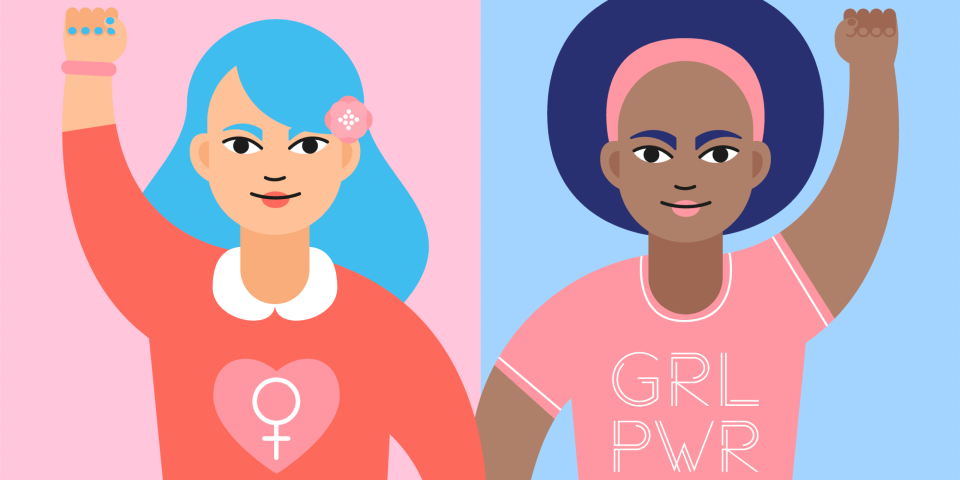

Konde.co presents a feminist dictionary once a month. The feminist dictionary contains feminist terms to make them easier for readers to understand.
Lately, we’ve been seeing a certain type of content on social media that appears very feminist. Women who decide to become stay-at-home moms are praised for “having the courage to choose their own path in life.” Women who choose to work and build a career are praised for being “independent.” Meanwhile, women who diligently take care of their skin, buy cosmetics, get beauty treatments, or change their appearance are said to be choosing to “love themselves.”
The message is almost always the same: it’s her choice. It’s her choice and her way of loving herself, as a woman.
This phenomenon also arises when a public figure’s personal choices intersect with positions of power. Recently, for example, the hosts of the “Pancatera” podcast faced criticism from netizens. The Pancatera group, comprising Marissa Anita, Caroline Soerachmat, Karina Soeja, and Karina Basrewan attended the 81st anniversary celebration of Indonesia’s Independence Day at the State Palace.
It wasn’t just Pancatera; several other celebrities, such as Nicholas Saputra, were also known to have attended the event. Not only that, but they posted photos of themselves with Indonesian President Prabowo Subianto and his son, Didit Hediprasetyo.
This clearly sparked criticism, particularly directed at Pancatera. This is because their podcast segment, “In Her View”, has long been known for its discussions on women, women’s emancipation, and women’s empowerment. Some members of the public then questioned how this stance could be reconciled with the decision to attend a state celebration perceived as extravagant. Meanwhile, outside that sphere, there are still many women and marginalized groups facing inequality and government policies perceived as not being on their side.
Read more: After the Days of Hell in Jakarta: The Death of Ita Martadinata as Recalled by Ita Fatia Nadia
On the other hand, some argue that they have the right to visit the Palace, meet with officials, attend official events, and even take photos with the president. However, the issue becomes more complicated when personal choices are treated as if they were always free from political consequences.
The question is not merely “why did they come to the Palace?”, but rather “what does their presence there signify, in the context of the public stance they have long cultivated?” When someone has a platform that explicitly addresses women, emancipation, and empowerment, the public certainly has the right to question how those personal choices relate to the values they have consistently communicated.
This is where the debate over “choice feminism” becomes relevant.
At first glance, there’s nothing wrong with the idea that women are free to choose. Doesn’t feminism, after all, advocate for women’s freedom to determine their own lives? We certainly don’t want to return to the old patterns where women who are stay-at-home mothers are considered powerless, women who enjoy domestic work are seen as un-progressive, women who marry are deemed failures as feminists, or women who enjoy makeup and fashion are viewed as being “oppressed by patriarchy.”
Read more: I’ll Be Back in Jakarta: Stories of Rural Women Who Move to the City
Feminism must indeed recognize women as subjects with agency. But agency is not the same as absolute freedom. A woman can make a conscious decision while simultaneously making that decision under conditions constrained by social structures. She may genuinely want to be a stay-at-home mom, but her desire still exists within a society that places the bulk of care work on women. A woman may genuinely want to work, but her decision to work may be shaped by low wages, gender discrimination, or economic necessity. She may genuinely enjoy skincare, but that enjoyment does not make the beauty industry and the body standards surrounding it immune to criticism.
The term “choice feminism” itself is not a single, established feminist theory. It is more often used as a critical term to describe a trend in popular feminism that places individual choice at the centre of women’s liberation politics. In its popular form, if a
woman feels she has freely chosen something, then that choice is considered feminist and criticism of that choice is instead viewed as a form of judgment against women.
Linda Hirshman, for example, criticizes the notion that as long as a choice is made by a woman, it must automatically be considered feminist. This kind of critique challenges the tendency to treat all personal decisions as politically equivalent, as if choices were never shaped by class, institutions, gender norms, or power relations. Nancy Fraser later helped expand this critique by showing how feminism can become detached from systemic critiques of capitalism and transform into a language of individualism that is easily co-opted by neoliberalism.
Read more: Indonesia’s Garbage Emergency: Scavengers Buried Under Mountains of Garbage in Bantar Gebang
However, criticism of “choice feminism” does not mean we must return to a feminism that prescribes a single “correct path for women.” The issue is not whether being a stay-at-home mom is more feminist than being a career woman, or whether wearing makeup is less feminist than rejecting beauty standards. The more important question is: under what conditions are these choices made?
Because women do not make choices in a vacuum.
Nancy Fraser’s thinking helps us see why this issue is important. Fraser critiques how parts of the second-wave feminist agenda, which originally aimed to dismantle structures of women’s subordination were later co-opted into neoliberal logic. Women’s struggle to break free from economic dependence, for example, can shift into a demand that women conform even more to the market: becoming flexible, competitive, productive workers capable of taking care of themselves.
The problem is not that women work. Rather, it is when women’s entry into the labor market is automatically regarded as proof that women have been liberated, while the structures of work, caregiving, wages, and social reproduction remain unchanged. Fraser points out that capitalism requires reproductive labor, giving birth, raising children, caring for the sick, managing the household, and maintaining social relationships, but this labor has historically been gendered and is often not valued as highly as paid work.
Therefore, when middle-class women are able to “choose” a career, we must ask: who then does their domestic work? Often, the answer is other women. Childcare providers, domestic workers, catering workers, laundry workers, or other informal workers take on a portion of this reproductive labor, often for low wages and with minimal protections.
Read more: Indonesia’s Garbage Crisis: The Irony of Women Amid the Stench of Garbage
This means that one woman may gain the freedom to work because another woman lacks that same freedom. This is one reason why feminism cannot limit itself to discussing individual choice.
The same issue is evident in beauty culture and social media. Rosalind Gill describes the “postfeminist sensibility” as a cultural sensibility that blends the language of women’s empowerment with individualism, personal choice, self-surveillance, body work, sexualization, and consumption. Women are portrayed as free, confident subjects capable of self-determination, yet at the same time, they are constantly pressured to monitor, discipline, and improve their bodies.
Women are no longer explicitly told, “You must be beautiful to be liked by men.” The message has shifted to, “Take care of yourself because you love yourself,” “Invest in yourself,” or “Be the best version of yourself.” The language is more pleasant. But the demand remains the same: women’s bodies must constantly be improved.
Angela McRobbie also demonstrates how postfeminist culture can transform the language of feminism into a kind of lifestyle individualism. Women are given the impression that various structural barriers have been overcome because they are now
“free to choose.” As a result, when women fail to meet certain standards, that failure can be attributed to themselves: not working hard enough, lacking self-confidence, making the wrong choices, or not taking good enough care of themselves. Thus, “choice” can become a new form of discipline.
In the past, women were controlled through prohibitions. Now, women can be controlled through the obligation to make the “right” choices.
Read more: 2025 Year-End Edition: Women’s Resistance in the Season of Arrests and the Year of #DemocracyApocalypse
This is clearly evident in the beauty industry. Using skincare products, makeup, and undergoing body treatments is not the issue. In fact, enjoying one’s own body and dressing up can be a pleasant, creative, and personal experience. What deserves criticism is the economic and cultural structure that turns women’s body insecurities into a commodity.
Sarah Banet-Weiser, in her study of popular feminism, demonstrates how feminist language, such as self-confidence, empowerment, and body positivity can coexist with commercial logic and consumer culture. Popular feminism may be highly visible in advertisements and on social media, but that visibility does not automatically translate into structural change.
So when a product says, “Love yourself,” we can enjoy the product. But we can also ask: why is the idea of self-love always presented as a product that must be purchased? Why does “self-care” so often mean correcting something about one’s body? And why must women keep spending money to look younger, fairer, slimmer, smoother, more fragrant, neater, or more feminine? So, who benefits from that feeling of never being enough?
These questions are not intended to judge women who use beauty products. Quite the opposite: feminist criticism should be directed at the structures that shape these choices, not at shaming the women who live within those structures.
This is where the concepts of “rights” and “access” become crucial. Within legal and political frameworks, “rights” typically refer to claims or guarantees that a person normatively possesses. However, having a right does not necessarily mean that a person is able to actually exercise or enjoy that right.
Read more: 2025 Year-End Edition: A Season of Persecution Without Transition in the Age of #DemocracyApocalypse
Jesse C. Ribot and Nancy Lee Peluso provide a highly useful analytical framework through *A Theory of Access* (2003). Ribot and Peluso distinguish between “property” which relates to the right to derive benefits from something and “access,” which they define as the ability to derive benefits from something. Therefore, access is not merely “having a right,” but is closer to what they call a “bundle of powers” a set of powers or capabilities that enable a person to derive actual benefits.
This is important when discussing “women’s freedom to choose.” Imagine a woman who legally has the right to work. Formally, that right exists. But does she have access to decent work and the necessary education ? Is transportation to the workplace available and safe? Is there access to childcare? What about social networks, freedom from discrimination, control over income, working hours, and the power to negotiate with her partner or family?
These questions show that rights are only one part of the possibilities for action. In Ribot and Peluso’s theory, access is shaped by various mechanisms and relationships including capital, markets, technology, labor, knowledge, authority, social relations, and identity. A person may have rights but lack the effective capacity to benefit from them.
If we apply this framework to gender issues, we can see that women’s “choices” are not merely a matter of individual will. They are a matter of who holds the power to make those choices possible.
Read more: Stop Tech Misogyny: The Long Chain of Gender-Based Cyber Attacks and Disinformation
Kimberlé Crenshaw introduced the term “intersectionality” to explain how the experiences of discrimination faced by Black women cannot be understood by examining the categories of “gender” or “race” in isolation. In certain experiences, gender and race actually shape one another and produce distinct forms of vulnerability. Patricia Hill Collins later expanded on this line of thought through the concept of the “matrix of domination”: various forms of power and inequality do not operate in isolation but are intertwined.
So when we talk about “women,” we need to ask: which women? Urban middle-class women do not have the same range of choices as poor women in rural areas. Those with steady jobs do not have the same choices as informal workers. Women without caregiving responsibilities do not have the same choices as single mothers. Similarly, women without disabilities do not have the same access as women with disabilities.
Even two women who both choose to be stay-at-home mothers may have different levels of agency if one has assets, economic security, access to education, and a supportive partner, while the other does not. Therefore, intersectional feminism reminds us that there is no single universal “women’s” experience.
What exists are women’s experiences shaped by gender as well as class, race or ethnicity, disability, sexuality, age, geographic location, citizenship status, and other power dynamics.
This issue becomes even more compelling when women’s choices move beyond the private sphere and into the political arena. Women do not merely make choices about work, marriage, their bodies, clothing, or lifestyle. They also make choices about where they stand when confronting power.
Read more: Stop Tech Misogyny: When AI Becomes a Tool for Manipulating Women’s Bodies
Therefore, the debate over women’s “choices” does not stop at the issue of women’s freedom to determine their political stances. The problem arises when their presence in spaces of power is called into question in the context of the public positions they have established. The state is not merely a neutral space where everyone gathers. The state has the power to make policies, allocate resources, set development priorities, regulate citizens’ lives, and determine who receives protection and who, in fact, faces marginalization.
Pancatera itself may claim to be independent and unaffiliated with the government. However, formal independence does not automatically eliminate questions regarding public accountability. One may be formally unaffiliated with the government, yet must still account for how proximity, access, or legitimacy derived from power might influence public perception of their position.
This does not mean that feminist women must distance themselves from power. On the contrary, feminism must enter the realm of power without losing the ability to critique that power. The issue is not “why did they go to the Palace?” but “what are they doing with the access they have?”
This is where “choice feminism” becomes problematic again. If the logic of “it’s my choice” is applied absolutely, then criticism of a person’s actions can be seen as an attack on individual freedom. Yet in public life, not all choices end with the person who makes them.
A public figure is free to attend an event. But when that person builds credibility based on certain values such as gender equality the public has the right to evaluate whether their public actions are consistent with those values. Freedom of choice does not mean freedom from the political consequences of those choices.
Read more: Stop Tech Misogyny: Misinformation on Social Media Used to Trap Victims of Human Trafficking
This is an important distinction between agency and accountability. Agency means that a person has the capacity to act and make decisions. Accountability means that those decisions can be called into question when they have an impact on others or when a person has taken a certain position in the public sphere. Therefore, saying “they have the right to choose to attend the Palace” and “the public has the right to criticize that choice” are not two contradictory statements. Both can be true at the same time.
Nancy Fraser helps us see this issue on a larger scale. In her critique of progressive neoliberalism, the language of emancipation can align consciously or unconsciously with economic and political interests that actually perpetuate inequality. Terms like “empowerment,” “independence,” “choice,” “confidence,” and “women can do anything” may sound very progressive. But this language loses its critical edge when it no longer questions who holds power, how power operates, and who benefits or is harmed.
This is because the representation of women does not always equate to women’s emancipation. One woman may sit near the centre of power, while other women remain low-wage laborers, unprotected domestic workers, victims of violence struggling to obtain justice, or members of marginalized groups whose lives are actually threatened by government policies.
Read more: Prabowo-Gibran’s One-Year Report Card From A Gender Perspective
If we return to Ribot and Peluso’s Theory of Access, this issue becomes even clearer. Not all women have the same opportunity to meet government officials, send messages to policymakers, have a platform with millions of listeners, or enter the exclusive spaces where political decisions are made. Therefore, when some women gain access to spaces of power, we need to view that access not only as an individual achievement but also as a political privilege.
Privilege does not necessarily mean someone is doing something wrong. Privilege means someone has opportunities to act that are not equally available to others. Access to power can be used to open doors for groups that have long gone unheard. But that same access can also make someone feel even more comfortable within the corridors of power to the point where the gap between them and those outside those corridors widens.
Therefore, criticism of Pancatera must also move beyond the “good feminist/bad feminist” logic. Women do not need to be perfect to speak about feminism. A feminist can be contradictory, can make mistakes, can change her mind, can enjoy luxury, and can enter spaces filled with privilege. What matters is the ability to reflect on that position and take public responsibility for it. Ultimately, the debate over “choice feminism” gives us the opportunity to reframe the question. Not just, “What do you choose?” but “What choices are available to you?” And further still: “Who makes those choices available or unavailable?”
This is the intersection between intersectional feminism and the Theory of Access. Freedom is determined not only by the existence of formal rights, but also by the actual ability to access the resources, security, networks, knowledge, and power that enable a person to live the life they choose.
Read more: Arrests at the End of the Day: Arrested While Hanging Out, Allegations of Sexual Harassment
Women may have the right to work, but without transportation, childcare, education, safety, and decent jobs, that right does not automatically translate into substantive freedom. Women may have the right to their own bodies, but if beauty standards, stigma, poverty, and the commercial industry continue to dictate the value of their bodies, then “choices” regarding those bodies take place within a power dynamic that is far from neutral.
So, perhaps a more appropriate feminist slogan is not simply, “Women are free to choose.” Rather: “Women must have access to the resources, security, and power that make those choices truly possible. ”For there is a vast difference between having the right to choose and having the power to act on that choice. And between the two lie the entire complex of issues surrounding class, labor, the body, capitalism, care work, discrimination, gender norms, and power relations.
That is where feminism should focus its efforts. Not on determining which choice is the most “feminist,” or who is most deserving of the label “feminist.” But on ensuring that more women have real power to determine how they want to live without those choices being limited by poverty, discrimination, violence, or structural inequality.
Because women’s choices remain important. Women’s agency remains important. But once someone has a platform, privilege, and access to power, those choices no longer belong solely to her.
They become part of the public conversation. And serious feminism isn’t just about giving women the freedom to choose. It also calls on us to take responsibility for what we do with the freedom, privilege, and access we have.
(Translator: Theresia Pratiwi Elingsetyo Sanubari)

















Comments are closed.