


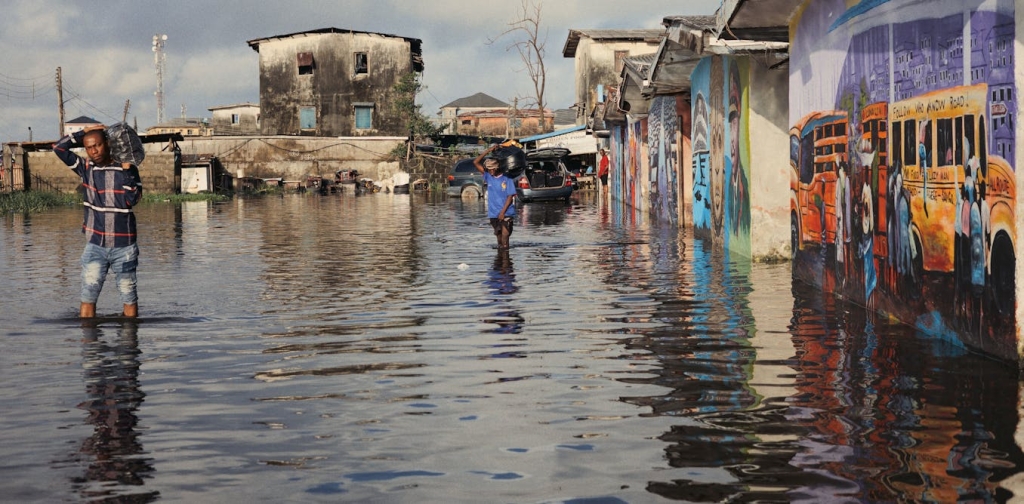

Multiple and often overlapping crises such as floods or drought due to climate change, violent conflict and economic instability are creating new forms of vulnerability. Collectively they’re known as a polycrisis. These have severe effects on countries in sub-Saharan Africa with high poverty levels where weak institutions and limited public resources make it harder to respond effectively.
Vidya Diwakar is a senior research fellow at the Institute of Development Studies and the deputy director of the Chronic Poverty Advisory Network. Her research focuses on poverty dynamics, violent conflict and intersecting crises, gender and education. She answers questions about her book Poverty in Polycrisis: Dynamic Pathways for Lasting Change.


What gap does your book seek to fill about understanding poverty?
The world now experiences increasingly interconnected crises with climate-related disasters, economic instability and violent conflict. These crises often overlap, and their effects build up to create new forms of vulnerability, making it harder for people to get out of poverty.
Consider the story of Aisha (anonymised), a woman our team interviewed in Borno, Nigeria. Aisha was once a successful farmer. But she now finds herself trapped in poverty after a series of crises. In 2013, Boko Haram killed her husband and three of her children, left her injured, and forced her and her remaining family to flee their village to a nearby settlement for internally displaced people.
Following this, Nigeria’s “cashless policy”, which restricted cash withdrawals to curb corruption, led to cash shortages. Aisha was forced to rely on credit-based sales for the charcoal selling business she had set up, leaving her without an income. The poor rains in Borno during the same year further reduced the ability of her remaining five children to support her financially.
Today, Aisha remains in the settlement camp, trapped in poverty.
In the world we live in, Aisha’s story is far from the exception as more people find themselves trapped in poverty due to compounding crises.
While there is extensive work on poverty and its drivers, the book focuses on how crises interact. The research draws on evidence from 15 high-poverty countries in regions of Africa and Asia. It examines how polycrisis is pushing people already in poverty into deeper deprivation. It also, surprisingly, shows how some people are able to escape poverty in these challenging contexts.
What about the intersection of climate-related disasters, economic instability and conflict?
When climate-related disasters, economic instability and violent conflict overlap, their effects mount up, making recovery much more difficult.
For example, a one-off drought might force a smallholder to sell some of their livestock or other assets. But they may be able to rebuild their business once the rains have come. However, if the drought is followed by high price inflation or broader economic volatility and more regular periods of drought, that might worsen the family’s food insecurity, push them into debt and make it harder to rebuild their income and assets.
These compounding forms of vulnerability have severe impacts in countries in sub-Saharan Africa with high poverty levels, weak institutions and limited public resources. Those already in poverty are being pushed deeper. And more people are falling into poverty for the first time and for longer periods of time.
The book also identifies strategies through which some people are escaping poverty. These pathways include relying on environmentally sustainable agricultural practices, diversification into off-farm livelihoods, and continuous economic and social adaptation to changing circumstances.
What about the role of governments and donors?
Our findings point to the fact that efforts and initiatives by governments and donors often reinforce harm, in three ways.
First, in response to crises, governments have adopted austerity measures. Nigeria’s fuel subsidy removal, for example, was accompanied by very little social assistance. This pushed many poor and vulnerable households deep into poverty.
Second, the standard response of fighting one crisis at a time can also make things worse for the world’s poorest. For example, evacuating populations to shelters during floods can increase disease transmission.
Third, there has been a decline in international aid. This will have severe consequences for poverty across future generations.
What are your recommendations?
The book recommends recognising how crises interact rather than addressing them in isolation.
Policies must must understand the challenges faced by poor and vulnerable people, and avoid causing harm.
This may sound obvious. But crisis responses often fail to account for these impacts.
Integrated policy responses could include cash transfers and social protection systems, early warning systems and other forms of disaster preparedness extended to rural and remote communities.
Peacebuilding activities can also help address root causes of both poverty and violent conflict.
Creating inclusive economic opportunities is important. Most people escape extreme poverty through “growth from below”: household-level strategies rather than top-down interventions alone. Yet government strategies seem to be going back to trickle-down economics.
Support from the international community remains important. This requires recommitting to predictable aid flows, especially to the poorest countries. Governments also have to expand their ability to raise and manage their public revenues, for example through taxes.
Complementary approaches, including debt restructuring, are important in the context of tightened aid budgets. They can ease fiscal pressures and help governments maintain pro-poor domestic investments.
What role can NGOs and the private sector play?
Non-state actors can contribute by supporting integrated responses that complement government action. These can include:
-
strengthening community-level resilience
-
supporting disaster preparedness at national and local levels
-
enabling livelihood adaptation
-
helping address vulnerabilities that emerge from overlapping crises.
Beyond service delivery, civil society organisations help ensure that responses are informed by people’s actual experiences. They can amplify the voices of marginalised groups in decision-making.
NGOs and community-based organisations can also act as intermediaries between communities and governments.
The polycrisis reveals how interconnected vulnerabilities have become today. Policy responses need to equally strive to be more interconnected. Collaboration across government agencies, international organisations and civil society is essential to create pathways out of poverty.



















Comments are closed.