


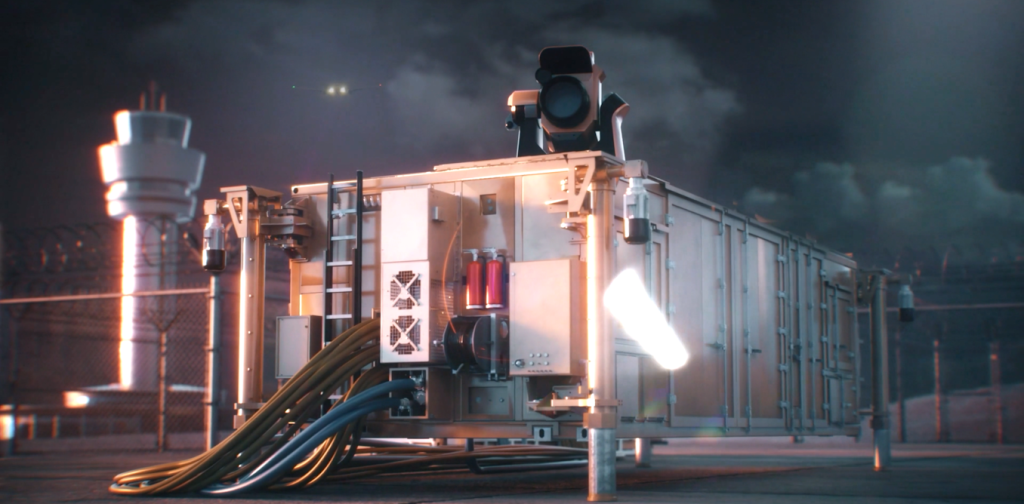

As conflict escalates following the US and Israeli attacks on Iran, and Iran’s subsequent retaliatory strikes, reports have emerged that Israel may have used laser weapons to shoot down rockets fired by Hezbollah from Lebanon.
While the reports are unconfirmed, video circulating on social media appears to show rockets being destroyed within moments of launching without visible intervention – consistent with the effect of a “directed energy weapon” such as a laser.



It wouldn’t be the first time Israel has used its cutting-edge Iron Beam laser air defence system, but the incident offers a glimpse into a changing landscape where high-tech militaries are scrambling to keep up with barrages of small rockets and cheap, increasingly capable drones.
What is Iron Beam?
Most defensive systems use rocket-propelled missiles against incoming threats. Iron Beam, however, uses a laser – also known as a directed energy weapon.
Where a missile destroys a drone, shell or rocket by crashing into it or exploding near it, Iron Beam destroys targets by burning them with an extremely powerful laser.
Manufactured by Rafael Advanced Defense Systems, which “serves as Israel’s High-Energy Laser National Center for Excellence and National Lethality Lab”, a smaller version of Iron Beam was first successfully tested in 2022. The system was first used in practice last year, to shoot down drones launched by Hezbollah.
Using a 100 kilowatt solid state laser mounted on a mobile trailer, Iron Beam can be strategically deployed and moved depending on the current threat vector, and adds an additional layer of defence to Israel’s existing, layered defensive systems.
How is it different to the Iron Dome, David’s Sling and Arrow air defences?
The biggest advantage of laser weapons over missiles is cost. A single Iron Dome interceptor missile costs about US$50,000 – which means the costs add up quickly when defending against large or frequent attacks.
Firing the Iron Beam laser costs a lot less. In 2022, Israel’s then prime minister Naftali Bennett said each shot cost around $US3.50, and more recent estimates suggest the cost may now have fallen as low as US$2.50 per shot.

The economics alone present a powerful motivator for militaries to develop and deploy these weapons.
Another significant advantage of Iron Beam and other directed energy weapons is that they don’t run out of ammunition. Whereas a missile battery needs to be reloaded after use, an energy weapons just needs power.
The only limiting factor for the number of shots is overheating due to the huge amounts of energy expended. Eventually a laser weapon needs to stop firing to cool down, or it will be damaged by the heat.
There’s little public information on how many shots these weapons can fire or at what rate before overheating, but it is widely assumed they can still easily outfire most conventional munitions.
Of course, Iron Beam doesn’t operate in isolation: Israel still possesses its other defensive capabilities. The cheaper Iron Beam can be used first, then backed up with other systems if needed.
The other limitation for directed energy weapons is range. They can’t reach as far as missiles such as David’s Sling or Arrow, so they are only useful for countering drones, artillery and short-range missiles.
Directed energy weapons on the ground can’t reach high-flying long-range ballistic missiles. What’s more, they are less effective in rainy, damp or cloudy conditions.
What role is Iron Beam playing in the current conflict?
Iron Beam (and other directed energy weapons being developed and deployed by other countries) are not intended to replace existing defensive systems, but to supplement them. The radically lower cost per shot provides far greater flexibility to counter “low cost” threats such as one-way drones or artillery shells.
In last year’s conflict with Iran, the United States, United Kingdom and Israel rapidly discovered they were expending large numbers of extremely expensive missiles to counter relatively cheap Iranian missiles, rockets and drones.
The US has responded with a crash course program to quickly arm its fighter jets with larger numbers of cheaper anti-drone rockets.
Directed energy weapons offer many of the same (if not greater) benefits for ground and naval-based defences.
Both the US and Israel reportedly expended a large proportion of their defensive missiles during the last conflict with Iran in 2025. Using directed energy weapons can also help preserve stores of these munitions.
Missile stockpiles are not easily replenished quickly. Even then, a large or sustained attack would quickly deplete them again.
An option that provides defence against shorter-range or slower threats allows the more expensive missiles to be held in reserve.
Where to from here?
War lasers may still sound like science fiction. But Israel is far from alone in developing and deploying them.
The US has tested laser drone and missile defences on navy ships. Both China and Japan have also tested naval and ground-based directed energy weapons.
For naval vessels in particular the benefits of directed energy weapons are immense. Reloading defensive missiles at sea is difficult, or often impossible, requiring a return to port.
In a high-intensity conflict (or a lower-intensity but prolonged conflict) this can present a significant challenge. It can also leave vessels vulnerable when they have depleted their missile stores, or are in port to rearm.
Running out of munitions is often a significant concern for defensive systems. Directed energy weapons lessen this worry – so we are likely to see them more and more as technology develops.






















Comments are closed.