



Seventy years ago, Britain confronted a dilemma. It wanted to remain a leading military power but no longer had the economic resources to sustain all the conventional capabilities it had inherited from the second world war.
The solution proposed in the 1957 Sandys defence white paper was technological. Guided missiles, Duncan Sandys argued, were transforming warfare so fundamentally that many traditional capabilities, including some crewed combat aircraft, would become obsolete.



In other words, by embracing this technological revolution, Britain could achieve defence on the cheap. Britain’s new Defence Investment Plan (DIP) reflects a similar strategic instinct. The technologies may have changed but the underlying dilemma has not.
Announcing the DIP in the House of Commons, Dan Jarvis, the defence secretary, said the UK would be making its “largest ever investment in drone warfare: £5 billion for strike, protector and surveillance drones across the Royal Navy, the Army and the Royal Air Force.”
Here are some of the key technologies discussed in the Dip.
Drone ships
At least a quarter of the £5 billion announced for drone warfare is going towards a “hybrid fleet,” a fundamental re-imagining of the Royal Navy. The UK’s sole ballistic missile defence capability – the Type 45 destroyers – will no longer be replaced by a like-for-like. Instead, a network of Crewed Combat Vessels (CCVs) will act as control hubs for specialised, uncrewed boats.
These would include Type 91 missile barges, Type 92 and Type 93 anti-submarine and underwater surveillance platforms, and Type 94 radar vessels. In principle, distributing the sense, decide and strike functions across the navy offers several advantages.
It could ease chronic personnel shortages by reducing crew requirements, extend radar and sonar coverage over a wider area, and make the fleet more resilient by dispersing combat power rather than concentrating it in a handful of expensive warships.
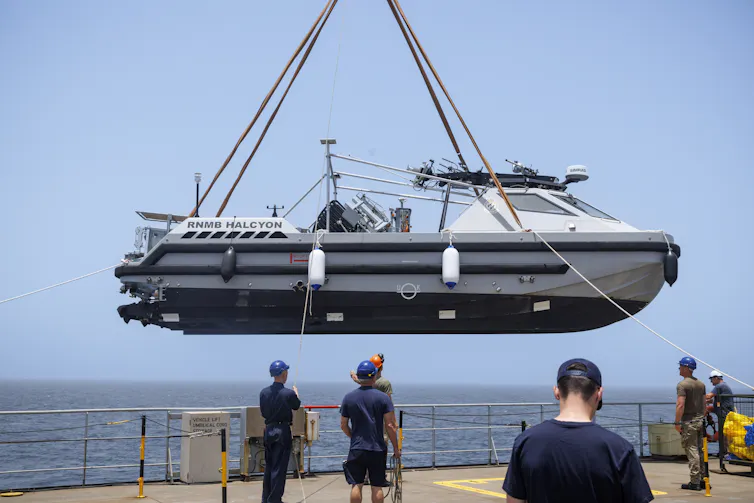
Uncrewed vessels could also be rearmed or maintained independently and without the design constraints of supporting sailors at sea. However, the challenges are significant.
The DIP envisages this concept becoming proven and operational before the Type 45 retires in the mid-2030s, despite the fact that resilient communications and electronic warfare protection for autonomous warships remain immature.
Nor is Ukraine’s use of naval drones a straightforward template. The Royal Navy’s principal tasks – particularly anti-submarine warfare in the High North and North Atlantic – are far more demanding than Ukraine’s use of maritime drones in the Black Sea.
While experiments such as using RFA Lyme Bay as a mothership for autonomous mine countermeasures (including drone minesweepers) are encouraging, retiring Britain’s only ballistic missile defence destroyers before the wider architecture has been proven would entail significant operational risk.
AI targeting network
The army’s Project Asgard illustrates the same technological philosophy in a different domain. Asgard aims to transform how – and how quickly – the army identifies and strikes targets, by linking sensors, armoured vehicles, drones and long-range weapons into a single, AI-enabled targeting network.
First trialled in 2025, Asgard is now receiving £370 million to develop an operational capability, reflecting the Army’s ambition to achieve a tenfold increase in combat power primarily through automation rather than expanded forces.
This idea has an important intellectual history. During the 1990s, the United States championed the concept of network-centric warfare: the proposition that superior information sharing would enable smaller, more agile forces to defeat numerically superior opponents. But Britain was soon concerned about the affordability and technological challenge of creating such highly connected forces, adopting in its place a lighter version: network-enabled capabilities.
The DIP suggests that the government now believes the technology is catching up with the theory. But old weaknesses remain. Networks only work if they survive. Communications can be jammed, satellites disrupted and software attacked, and Russia has the electronic warfare capabilities that could, without adequate safeguards, do all three.
‘Loyal wingmen’
It is also the case that what has worked at smaller levels now needs to be scaled across Nato. If it works, Project Asgard would provide Nato land forces with the ability to control long-range weapons of their own, reducing their reliance on air forces which will need to focus on supressing and destroying enemy air defences.
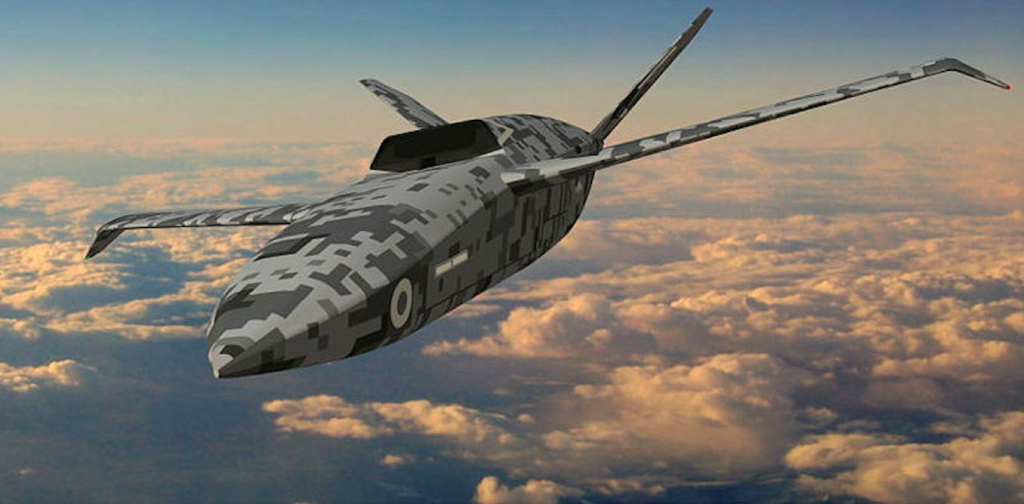
That task is motivating the DIP’s investment in Collaborative Combat Aircraft (CCAs) – uncrewed platforms that will fly alongside the RAF’s Typhoons and F-35s.
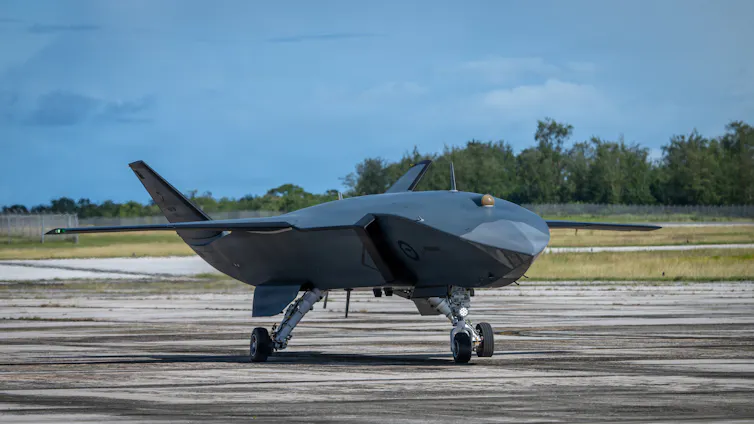
These “loyal wingmen” drones would support crewed aircraft by acting as scouts, decoys, absorbing enemy fire or jamming enemy radars. They could be controlled by the pilot of the combat jet, or work autonomously.
Systems such as the MQ-28 Ghost Bat are at an early stage of development. To be militarily useful CCAs must combine long range, high speed, low observability, resilient data links and meaningful payloads, requirements that quickly approach the complexity, and potentially the cost, of the crewed aircraft they are intended to complement.
Will it be cheaper?
Against these challenges, the government’s headline commitment of £5 billion on these systems therefore seems more like a down payment than the full mortgage. Spread across four years, three armed services and an exceptionally diverse range of programmes, it is less transformative than some may believe, and certainly not on the timelines some think are necessary as tensions continue with Russia.
The unit costs of what will be specialist equipment may remain prohibitively expensive. Take the hybrid Navy as an example. The autonomous systems in question require resilient communications, sophisticated sensors, electronic warfare protection and high engineering reliability, meaning the combined cost of CCVs and their uncrewed flotillas could approach that of the destroyers they replace.
Even if the funding can be found – and there are good reasons to question whether it can – Britain must still demonstrate that its defence industry can deliver this technology-intensive force. Expanding military output requires far more than larger budgets: it demands additional factory capacity, skilled workers, shipbuilding infrastructure and resilient supply chains. This is particularly true for autonomous systems whose military value depends on being produced, sustained and replaced at scale.
The DIP rests on three assumptions: that autonomous systems mature quickly, prove affordable and can be produced at scale. The Sandys Review rightly foresaw the missile age but underestimated the staying power of conventional forces; new technologies reshape warfare but they rarely replace its enduring fundamentals.
If Britain is to bet on autonomy, therefore, it also needs the spending profile to make that bet credible. After all, the most important judgement on the DIP will not be that of future historians, but of the occupant of the Kremlin today.




















Comments are closed.