


France’s Ministry of Culture handed over three Malagasy skulls to Harea Georges Kamamy, the reigning king (ampagnito) of the Sakalava people in Menabe, a western region of Madagascar, on 26 August 2025. The skulls had been held for more than a century in the Muséum national d’Histoire naturelle in Paris.
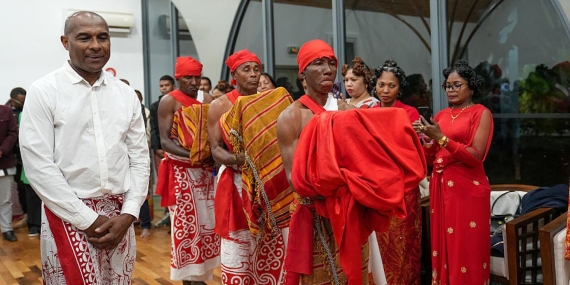
One was identified as belonging to Toera, the Menabe king killed by French colonial troops in 1897. When handed over, it was placed in his tomb to complete his skeleton. A “bathing of the relics” ceremony (fitampoha) completes the process of the late ruler becoming an ancestor. This ceremony also consecrates the accession of the new sovereign.


Anthropologist Maurizio Esposito La Rossa’s research on the Sakalava monarchy has resulted in a new book, Sovereigns of Gold, Spirits of Silver: Ritual, History and Hierarchy in Madagascar (HAU Books, in press). This work informs his explanation of what the return of the skulls means, spiritually and politically, and why it has proved divisive.
What do physical relics mean to the Sakalava people?
Among the Sakalava people of the Menabe region, royal relics (dady) have been central to political life since the first kingdoms were founded in the 17th century. Made from fragments of the skull and other parts of the deceased sovereign’s body, relics carry the generative power (hasina) of royal ancestors. It is this power that legitimises the rule of the living king. The relics are made by ritual specialists drawn from local groups, and allow the dead sovereign to return as a spirit, or tromba.
It’s a practice that embodies the alliance between the political power of the “stranger-king” (anthropologist Marshall Sahlins’ term for a ruler who originates from elsewhere) and the ritual authority of the “masters of the land” who legitimise him.
What has your research in Madagascar explored?
My fieldwork in Madagascar (2015-2025) focused on how royal rituals reframe the dynastic conflicts between the “gold” and “silver” princely branches, hence my book’s title.
“Gold” princes are the legitimate heirs: they alone may rule, and they alone possess relics. “Silver” princes, descended from a king’s sisters or secondary wives, have no right to hold relics, nor to have relics made from their own remains after death.
Historically, silver princes faced a choice: stay and take up ritual office within the existing kingdom, or leave to found a new one elsewhere, stealing or fabricating relics of their own. Many of them chose the second path. Combined with the slave trade conducted with foreign powers, this dynamic drove the Sakalava monarchy’s expansion along the west coast between the 17th and 19th centuries.
What does the return of the skulls mean?
The return of Toera’s presumed skull belongs to a much longer history of relic politics involving the French, the Sakalava and the Merina.
In the Sakalava monarchy, succession rules have long been flouted, and polygamous marriage strategies have produced no shortage of princes with a claim to the throne. Possessing the relics – or even just credibly claiming to – has for centuries been the decisive factor in legitimating royal power. It’s driven disputes that continue today.
Relics were also a target of the two conquests the Sakalava kingdoms suffered: by the Merina kingdom of Madagascar’s highlands in the 1820s, and by the French colonial army at the end of the 19th century. When the French took control, they returned relics to Sakalava rulers after the Merina had earlier confiscated them. In doing so, they helped restore the rulers’ political legitimacy, enabling the French to govern through them as local intermediaries.
The latest gesture has been framed as an act of reconciliation between former coloniser and formerly colonised. But it has also reopened tensions within Madagascar: between the central government and the local Sakalava monarchy, and between rival dynastic branches contesting the Menabe throne.
The restitution was negotiated between the French and Malagasy governments, with the Malagasy side represented above all by then-president Andry Rajoelina, a Merina from the capital. Menabe royals have complained they were not adequately consulted over how the ceremony was organised, and the Menabe king regretted that the skulls were handed to Madagascar’s government instead of the royal family. One royal descendant, Joe Kamamy – descended from Toera through the female line, and therefore ineligible to rule under patrilineal succession – reportedly sought to claim the skull for himself, to found a new tomb and a new kingdom.

This echoes the age-old pattern of “silver” princes seeking to become “gold” kings by founding kingdoms of their own.
It would be too simple to read this restitution solely through the lens of former coloniser versus formerly colonised. That decolonial framing has real merit – it does justice to a history of dispossession ignored for far too long.
But it can also obscure internal power relations. In doing so, it can legitimise forms of domination exercised by local elites and, in some cases, reignite conflicts among them. Restitution, while undoubtedly a gesture of repair, is also a political act that can redifine (or consolidate) pre-existing local hierarchies.










Comments are closed.