


“The Canadian Armed Forces (CAF) is rebalancing its global operational commitments to better align resources with evolving defence priorities in an increasingly complex security environment. This includes closing Operations KOBOLD, SNOWGOOSE, SOPRANO, and CROCODILE, and reducing its contribution to Operation CALUMET. Approximately 50-60 CAF members currently assigned to these missions will be progressively reintegrated into higher-priority roles supporting operations at home and abroad.” — Department of National Defence announcement, July 17, 2026
Canadians could be forgiven for thinking this announcement about the end of Canada’s participation in United Nations peacekeeping missions in Cyprus, South Sudan and the Democratic Republic of Congo is little more than bureaucratic housekeeping. In fact, it effectively marks the finale of 70 years of Canadian involvement in UN peacekeeping.



More fundamentally, it represents the triumph of one Canadian narrative — or even mythology — over another.
There are few countries more psychologically invested in peacekeeping than Canada. Canada as global peacekeeper is a national symbol or brand, forged in the 1956 Suez crisis, when Lester B. Pearson and other Canadian officials basically invented peacekeeping to diffuse the ill-conceived British-French-Israeli invasion of Egypt and the occupation of the Suez canal zone.
For decades thereafter Canada was heavily committed to United Nations operations, peaking at nearly 4,000 personnel deployed in places like Cyprus and the Golan Heights. These were often UN “Pacific Settlement of Disputes” missions, where monitoring, buffer-zone enforcement and policing roles were central.
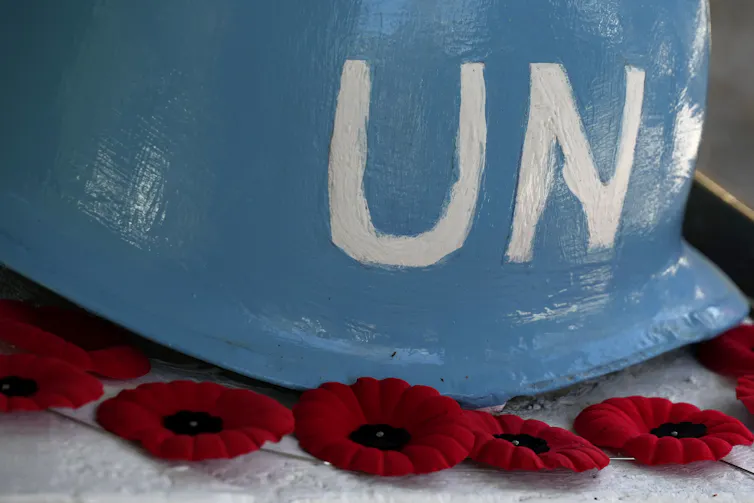
Peacekeeping as a Canadian brand
Peacekeeping of this sort seemed to fit well with Canada’s Cold War, middle power posture. The image of the Canadian Forces in blue berets, driving vehicles painted white with UN insignia and operating as soldier-diplomats in relatively non-violent situations was popular with Canadians, whether it conformed to reality or not.
But like all mythologies, this one was a mix of truth and fiction. In Cyprus and the Golan, for example, more than three dozen Canadians died.

By the 1990s, Canada’s role in UN peace support operations had changed significantly. Soldiers were increasingly deployed in violent and complex operations in Somalia, the Balkans and Rwanda.
Canada’s mission in Somalia ended in disgrace when Canadian soldiers tortured and murdered a civilian teenager. A few years later in Rwanda, Canadian Gen. Romeo Dallaire commanded a UN mission that was powerless to stop a genocide.
Such traumatic experiences in post-Cold War UN operations gradually gave rise to a second Canadian mythology. This resides chiefly within Canada’s defence establishment, where Canadian involvement in peacekeeping is sometimes seen as a regrettable detour from a long and illustrious history of war fighting.
According to this narrative, UN peacekeeping operations are often ill-conceived, beset with vague objectives, under-resourced, sometimes saddled with poorly trained and inadequately armed troops and hindered both by the UN bureaucracy and weak political commitments from contributing country governments.
For these reasons, UN missions in places like Rwanda, Haiti and Congo are largely considered failures. As a result, Canadian defence officials have often resisted Canada’s participation in UN peacekeeping missions.
Bob Rae, Canada’s ambassador to the UN from 2020-2025, recently reflected on this resistance:
“The opposition within the Department of National Defence to UN peacekeeping commitments is deep seated and thoroughly embedded in the current military establishment. During my five years at the UN, I had firsthand experience with this institutional aversion.”

Defence Department hostility
I too witnessed this hostility towards the UN more than 20 years ago when I worked for Defence Minister Bill Graham in Paul Martin’s government.

One day, Graham received a call from Canada’s UN ambassador, who expressed frustration over his inability to get the Defence Department to agree to the assignment of a mid-level officer to a peacekeeping mission in Africa. Graham told the ambassador he would ask military leaders to reconsider the request. They refused to do so; one more mid-level officer to a UN mission was considered one too many.
This longstanding Defence Department attitude has ultimately resulted in gradual dwindling of Canada’s contributions to UN missions — so much so that following the department’s July 17 announcement, the country that invented peacekeeping will barely crack the Top 100 in the world in personnel contributions to UN missions.
It’s in that light that this announcement, carried out in the dead of summer presumably to avoid attention, should be examined. It marks the final step in the triumph of one national peacekeeping mythology over another.











Comments are closed.