


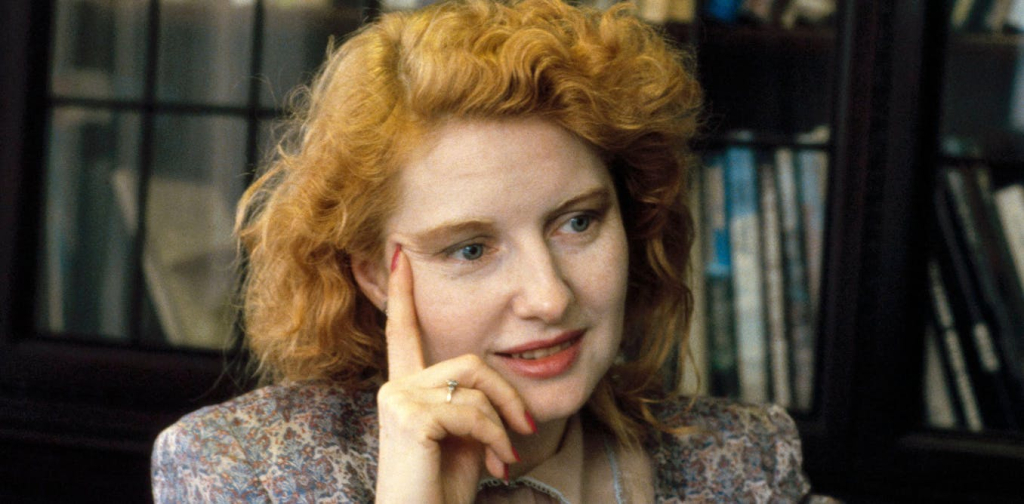

In 1976, a Playboy model turned feminist sex-researcher called Shere Hite did hundreds of television and radio appearances promoting her book, The Hite Report: A Nationwide Study of Female Sexuality. She went on Good Night America dressed in a high-necked Victorian white silk blouse, huge faux-pearl earrings and matching necklace, her face framed by a cloud of apricot curls.
The host, Geraldo Rivera, grinning under his 1970s handlebar moustache, asked her to summarise her book’s findings. “Don’t get hung up, turned off or turned on by the explicit language,” he warned the audience. Hite outlined the great provocation of the work: “Intercourse doesn’t lead to orgasm for most women.”



Using a survey methodology, Hite found women required clitoral stimulation to orgasm. And while they knew about the clitoris because they masturbated, they rarely asked for it in straight sex. Instead, they gritted their teeth or faked it, the loudest way to be silent about sexual dissatisfaction.
To understand why, Hite held sex up to feminism, and found it was shot through with power and inequality. Society insisted that women – like men – should find their greatest pleasure in penetrative sex: the man penetrating, the woman penetrated. Hite declared: “Sex is sexist … Women’s sex lives clearly reflect their second-class position in society.”
The book exploded across the US. It was translated widely, became a bestseller in Japan, was banned in Brazil and smuggled into East Germany. To date 50 million copies have been sold, making it the 30th bestselling book of all time.
For a time Hite was everywhere, and everyone loved the book. Erica Jong, author of the sex-forward 1973 novel Fear of Flying wrote in the New York Review of Books: “Read The Hite Report if you want to know how sex really is right now.” The National Observer described it as a “bombshell”. Even Playboy praised her redefinition of orgasm from something that men “give” to women, to “something she works toward herself”.
As I found in my archival research for my recent book, The Book That Taught the World to Orgasm and then Disappeared: Shere Hite and the Hite Report, she received thousands of letters from readers.
Women wrote to her from the suburbs, praising her for the way the book made them feel normal. Men working in factories, on oil rigs, and in prison wrote to her too. This was often the first book about feminism they had ever read.
Anti-feminist backlash
Partly inspired by the plentiful fan mail, she began The Hite Report on Male Sexuality, which was published in 1981, but by this time, anti-feminist storm clouds were gathering on the horizon. Critic Philip Nobile argued in New York Magazine that she “whipped herself up into an antipatriarchal frenzy” and “totally neglects biology”. Men, Nobile claimed, were “naturally promiscuous”.
This biological explanation for social inequality was one from the New Right, a grassroots coalition of right-wing figures including televangelist Jerry Falwell and mega-church minister and bestselling apocalyptic sci-fi writer, Tim LaHaye who entangled biblical and scientific explanations to fight the forces of feminism.
Right-wing women too pushed biological explanations. Conservative activist Phyllis Schlafly and founder of conservative anti-feminist group Eagle Forum argued that “the man is orgasm oriented” while the “woman is engulfed in romanticism”.
The New Right also engaged in the politics of grievance, arguing that ordinary Americans had been left behind by civil rights and feminism. Any gains for feminists such as women working, especially in traditionally male professions, or improved laws and services around rape and domestic violence, were necessarily a loss for them.
This zero-sum explanation was particularly appealing at a time of economic downturn and unemployment which was caused by global oil crises, though as journalist Susan Faludi wrote in her now classic text Backlash, feminism got the blame.
Ronald Reagan upheld this view, remarking in a 1982 address on the state of the economy: “Part of the unemployment is not as much recession as it is the great increase in the people going into the job market and, ladies, I’m not picking on anyone, but because of the increase in women who are working today…”
Right wing forces of the 1980s resemble the right today; the loops and echoes are striking. The misogynists of the manosphere today misuse evolutionary psychology to argue that domination is men’s nature and deception and promiscuity are women’s. They also suggest that men’s natural instincts are curbed by a world beholden to feminist interests.
Trad wives – communities of right-wing, “traditional wife” women who advocate through social media for hierarchical gender roles – also suggest that women are not biologically built for casual sex or paid work, but monogamy, baby-making and submission. Both right-wing women of the 1980s and trad wives now tend towards the conspiratorial. These right-wing women painted feminists as elites who had taken over the government by devious means.
They, contrarily, were “a little flock pitted against … the president, the federal bureaucracy, the mushrooming feminist organisations”, as Rosemary Thompson, director of Schlafley’s Eagle Forum put it.
Today trad wives sometimes incorporate an anticapitalist edge into their conspiracy theories. As one influencer claimed, feminism is a “lie corporations created to get more workers and more money”. In the 1980s as now, we see how ideas that began on the fringes of the political right became mainstream.
By 1987, when Hite published the third book in her trilogy, Women and Love, media vilification intensified. From the London Review of Books and the Washington Post to the New York Post and Penthouse, all reviewed her negatively. The tempest against feminism was in full swing.
Republican strategists had learned a lot from right-wing women and began to centre anti-feminism, gender and sexuality in their electoral platform alongside economic conservatism and national defence. Ronald Reagan’s victories owed a lot to these women and by 1987 he’d been in office for seven years, pushing anti-feminist politics widely.
Politics leaked into culture too. One of the bestselling books of the year was Donald Trump’s The Art of the Deal and one of the most popular films was Fatal Attraction, where the feminist career woman “psycho” is literally killed off by the stay-at-home mom.
With Fox TV camped outside her house and the media becoming increasingly harassing, Hite fled from the US, settling in Europe until her death in 2020. Her work largely disappeared from public memory.
The story of Hite and The Hite Report helps us understand how one woman lived the backlash and how she came undone. This shows us that backlashes are not inevitable, but political, that there is often period of real progress, followed by a clampdown by those who want to maintain their power. Shere Hite’s story helps us all to see what they are up against.
This article features references to books that have been included for editorial reasons, and may contain links to bookshop.org; if you click on one of the links and go on to buy something, The Conversation UK may earn a commission.




















Comments are closed.