


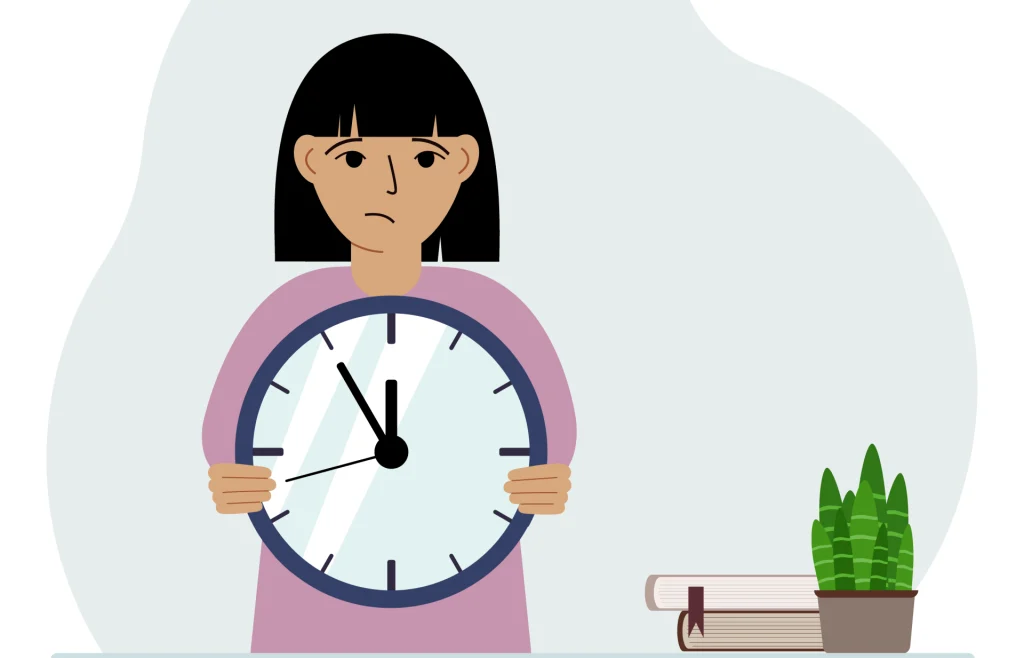

The clock keeps ticking.
For women, it doesn’t just mark time. It turns into a loud alarm.



At a certain age, often even before a woman truly knows what she wants, time starts to feel threatening. It no longer feels like open space or possibility, but like a warning that keeps repeating itself.
The first time I felt this pressure was when I finished my undergraduate degree. As soon as I graduated—almost immediately—the questions began. They were not about what I wanted to learn next, the ideas I was interested in, or the paths I hoped to explore. The question was simple, but heavy: what’s next—work or marriage?
That question sounds neutral, but it is deeply shaped by social expectations. In many societies, a woman who has completed her undergraduate studies is already seen as standing at a crossroads that should lead quickly to marriage. Work, in this context, is not framed as a space for growth or exploration, but as proof that she is no longer a burden to her family. Marriage or work is not offered as a choice; it is presented as an obligation.
Read More: Learning Peace from a Small Hamlet in Temanggung, We Call It Nyadran Perdamaian
I thought, at the time, that the pressure might fade once I chose to continue my education. I was wrong. Now, as a graduate student, the same cycle repeats itself—unchanged, and in some ways, more intense. The questions are the same, but the tone has hardened. Especially after I turned twenty-five, the pressure became heavier, more urgent, more unforgiving. Time no longer feels patient. It feels demanding.
And it doesn’t stop there. If a woman gets married, the next question quickly follows: when will you have children? After the first child, another question appears just as predictably: when will you have another one? The demands keep piling up. She is expected to take care of her husband, her children, and the household—often all at once. If she fails, she is labeled a failure not only as a woman, but as a wife, a mother, and even as a daughter. The family’s dignity, its moral image, is placed squarely on her shoulders, measured by how well she manages domestic life. It is exhausting. Relentlessly exhausting.
Read More: Why Gender Sensitivity Matters for Disaster Risk Reduction in Indonesia
In the middle of all this pressure, I often think about one of my favorite romantic comedies, When Harry Met Sally… (1989). There’s a scene where Sally tells her friends that she’s broken up with Joe. Alice and Marie are shocked because they think Sally and Joe are a perfect couple. Sally calmly says, “I just said to myself, you deserve more than this, you’re 31 years old…” Before she can even finish, Marie jumps in: “And the clock is ticking.” The moment is funny—but also deeply revealing. Beneath the joke is a harsh truth: women are expected to live alongside an invisible clock that’s always ticking, watching, judging, and deciding when we are running out of time.
I said no to marriage. For me, I was still young. But that “no” wasn’t seen as a choice—it was seen as defiance. Over time, the questions turned into pressure, then into force, delivered through sharp words and quiet intimidation. It felt like time didn’t allow me to hesitate. Like my body had a deadline, and missing it meant failure.
What hurts most is the double standard. None of this pressure was ever directed at my brother, who is even older than I am. When he didn’t have a job, the house was still open to him. He was seen as “still figuring things out,” “not ready yet,” “normal.” There was no panic, no pressure, no ticking clock surrounding his body. We are both children in the same family, yet time treats us very differently.
Baca Juga: The Invisible Breadwinners: Stories of Women’s Care Work in Balodano
One sentence from my mother has stayed with me. She once said she didn’t want to “raise an old virgin.” The words were short, but they landed hard. I remember thinking: why “virgin”? Why is morality—so tightly tied to purity—always pushed onto women’s bodies and never onto men’s? Why do shame, fear, and moral judgment fall only on women, when she also has a son? Moments like this make one thing clear: time is not neutral. It works hand in hand with language, morality, and power to tighten control over women’s bodies.
At twenty-five, the ticking stopped being background noise and became an order. Women are pushed to secure their future in the middle of economic, social, and political uncertainty, even if that means taking any job at all, just to avoid being seen as a burden. Our worth is reduced to function: get married, or at least don’t be a problem.
But I refuse both options as they’re presented to me. Not because I reject love or work, but because I reject the way society narrows women’s lives. I believe women have far more possibilities than these two paths. Choices made consciously, not out of fear; that feel freeing rather than suffocating. Choices that recognize that life does not have to follow someone else’s timeline.
This is when I realized that time isn’t experienced the same way by everyone. It is gendered. It is designed to discipline women, restrict their movement, and measure their worth. The same clock moves much more slowly for men, giving them space to fail, to pause, and to search for direction without shame.
Read More: Why Period Poverty Is a Social Justice Issue
Still, despite all the pressure and control coming from inside my own home—whether intentional or not—I love them. That love is real, even though the wounds are too. And within this unequal space, I have found my own way to resist. My resistance isn’t loud or dramatic. It is quiet, symbolic, and often invisible. But it exists—in my persistence, in my refusal to give my time and my body away.
When “home,” the place that is supposed to feel safest, fails to offer safety, comfort, and moral support, I believe those things can still be created. If not fully for ourselves, then for the future. For my child one day, or maybe yours, for nieces, younger siblings, and other women around us. So they don’t grow up hearing voices that make them doubt themselves. So the ticking clock in their lives doesn’t turn into an alarm of fear, but into space—to choose, to breathe, and to fully exist.
(Editor: Salsabila Putri Pertiwi)























Comments are closed.