




We have experienced several heatwaves in the UK this summer – workers suffering from heat stress is among the biggest causes of weather-related sick leave here. Very high temperatures can cause symptoms like heat rashes and cramps, or even exhaustion and heatstroke.
But our recent survey of workers in seven climate-exposed sectors shows that extreme weather caused by climate change also affects their health, wellbeing and productivity in colder months.


The Climate Change Committee, which advises the UK government, recently assessed the risks and what is needed to mitigate our changing weather. But its report and the debate about climate adaptation have largely overlooked the plight of workers.
In the UK, like many other parts of the world, they are already suffering from – and adapting informally to – increasingly disruptive weather, often without adequate support.
In June, the Health and Safety Executive (HSE), the UK’s workplace regulator, issued a heat health alert that urged employers to act to make sure their workers are protected from heat – albeit without giving any guidance on what “too hot” means.
There’s currently no law on the maximum working temperature allowed in the UK. Nor has there been a comprehensive analysis of the short- and long-term impacts of the heatwaves in 2022 on UK workers’ health.
Those effects result from the UK’s climate having altered in a number of ways. The decade from 2015-2024 was 10% wetter and 1.24C° warmer than the 1961-1990 period. The past three years have all been among the top-five warmest on record, with the 40°C threshold exceeded in July 2022 for the first time since the mid-19th century.
The economic impact of this climate change will be huge. While there is not yet a full estimation of the costs for the UK, estimations from climate-induced weather hazards more broadly – of flood damage, failed infrastructure and falling productivity – predict a decline in the value of GDP (gross domestic product) of between 3 and 7%.
There are also indirect losses due to decreased productivity, absenteeism and performance inefficiency.
Our survey of 1,288 workers across the seven climate-exposed sectors reveals that heat stress is now one of the leading causes of weather-related sick leave – 40% of workers who had taken sick leave due to weather factors said heat was a factor.
But heat is only part of the problem. The rapidly changing climate in the UK is affecting workers across a range of hazards including flooding, drought, storms, snow and ice, and air pollution-related conditions.
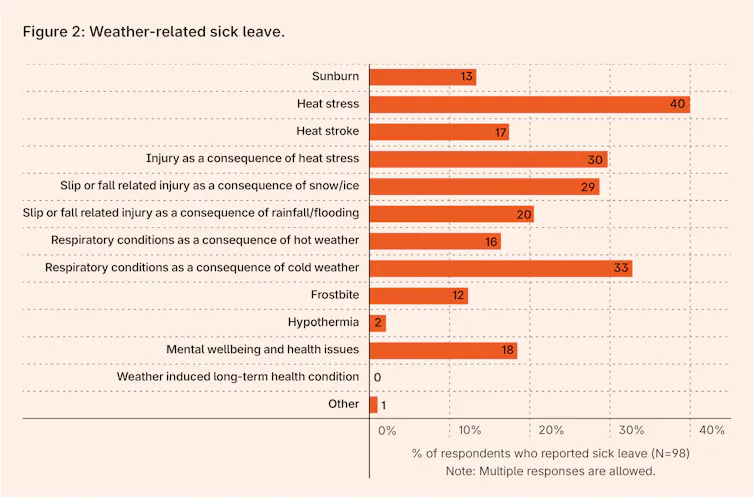
Our survey gives the first UK evidence base beyond heat alone on how workers are affected by climate change – and how they are adapting to these changes.
Of workers in agriculture, construction, education, the emergency services, entertainment and sports, transport, and health and social care, more than half (56%) reported being affected by at least one extreme weather event at work in the past 12 months.
While there were significant differences between sectors in specific weather effects, those working in agriculture, emergency services and transport and logistics reported the highest exposure across all weather categories.
Among those affected, four in 10 (44%) of workers reported that their wellbeing had been negatively affected by drought, while nearly three-quarters (72%) said they had been negatively affected by extreme heat events.
Changing the working day
The organisation of the working day is also affected, with 44% of respondents reporting they had changed their working patterns because of extreme weather events.
Half of affected workers (50%) had to reduce their working time. One in five affected workers (18%) said they’d had to stop work because their employer had suspended operations, while 14% reported taking time off work.
Employers, though, don’t seem to be ready to respond to these extreme challenges.
Our findings show that only 26% of employers have a climate adaptation or extreme-weather plan, according to their workers. Only 30% of workers said they have received training on managing weather impacts at work. Emergency services is the sector in which most workers felt their employer was not doing enough to address the effects of extreme weather.
The Trades Union Congress (TUC) is campaigning for the HSE to introduce a maximum heat-working temperature, in line with international guidance. This would require employers to take steps when the temperature exceeds 24°C and workers feel uncomfortable.
Studies show that public support for climate policies increases when extreme weather events – and their costs – are explicitly linked to climate change.
We believe setting a maximum heat temperature for UK workplaces is now urgent, along with establishing clear regulatory standards and frameworks that mandate actions to protect workers’ wellbeing. The UK’s current spells of hot weather seem the perfect moment for bolder demands and rapid action.




















Comments are closed.