


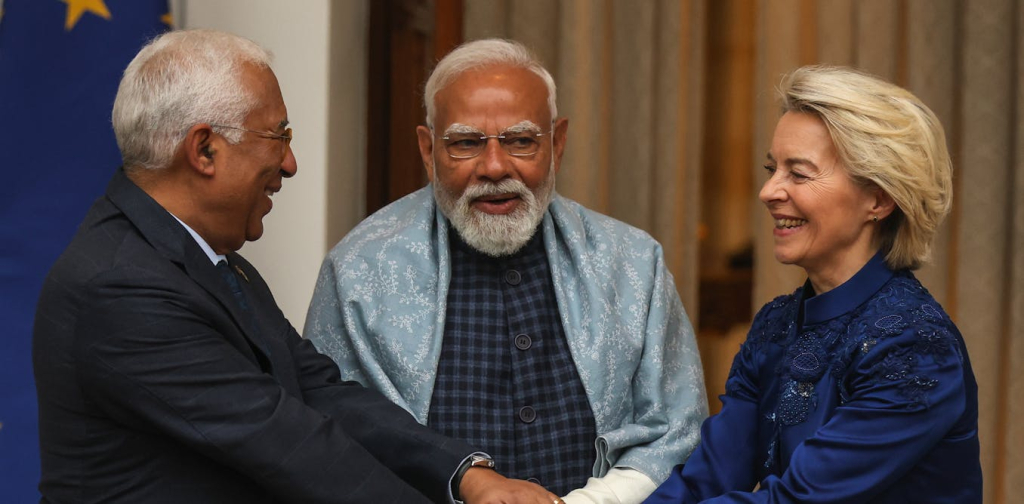

The “mother of all deals”: that’s how European Commission President Ursula von der Leyen described the new free trade agreement between the European Union and India, announced on Tuesday after about two decades of negotiations.
The deal will affect a combined population of 2 billion people across economies representing about a quarter of global GDP.


Speaking in New Delhi, von der Leyen characterised the agreement as a “tale of two giants” who “choose partnership, in a true win-win fashion”.
So, what have both sides agreed to – and why does it matter so much for global trade?
What has been agreed
Under this agreement, tariffs on 96.6% of EU goods exported to India will be eliminated or reduced. This will reportedly mean savings of approximately €4 billion (about A$6.8 billion) annually in customs duties on European products.
The automotive sector is the big winner. European carmakers – including Volkswagen, BMW, Mercedes-Benz and Renault – will see tariffs on their vehicles gradually reduced from the current punitive rate of 110% to as little as 10%.
The reduced tariffs will apply to an annual quota of 250,000 vehicles, which is six times larger than the quota the UK received in its deal with India.
To protect India’s domestic manufacturers, European cars priced below €15,000 (A$25,500) will face higher tariffs, while electric vehicles get a five-year grace period.

India will almost entirely eliminate tariffs on machinery (which previously faced rates up to 44%), chemicals (22%) and pharmaceuticals (11%).
Wine is particularly notable – tariffs are being slashed from 150% to between 20–30% for medium and premium varieties. Spirits face cuts from 150% to 40%.
In return, the EU is also opening up its market. It will reduce tariffs on 99.5% of goods imported from India. EU tariffs on Indian marine products (such as shrimp), leather goods, textiles, handicrafts, gems and jewellery, plastics and toys will be eliminated.
These are labour-intensive sectors where India has genuine competitive advantage. Indian exporters in marine products, textiles and gems have faced tough conditions in recent years, partly due to US tariff pressures. That makes this EU access particularly valuable.
What’s been left out
This deal, while ambitious by India standards, has limits. It explicitly excludes deeper policy harmonisation on several fronts. Perhaps most significantly, the deal doesn’t include comprehensive provisions on labour rights, environmental standards or climate commitments.
While there are references to carbon border adjustment mechanisms (by which the EU imposes its domestic carbon price on imports into their common market), these likely fall short of enforceable environmental standards increasingly common in EU deals.
And the deal keeps protections for sensitive sectors in Europe: the EU maintains tariffs on beef, chicken, dairy, rice and sugar. Consumers in Delhi might enjoy cheaper European cars, while Europe’s farmers are protected from competition.

Why now?
Three forces converged to make this deal happen. First, a growing need to diversify from traditional partners amid economic uncertainty.
Second, the Donald Trump factor. Both the EU and India currently face significant US tariffs: India faces a 50% tariff on goods, while the EU faces headline tariffs of 15% (and recently avoided more in Trump’s threats over Greenland). This deal provides an alternative market for both sides.
And third, there’s what economists call “trade diversion” – notably, when Chinese products are diverted to other markets after the US closes its doors to them.
Both the EU and India want to avoid becoming dumping grounds for products that would normally go to the American market.
A dealmaking spree
The EU has been on something of a dealmaking spree recently. Earlier this month, it signed an agreement with Mercosur, a South American trade bloc.
That deal, however, has hit complications. On January 21, the European Parliament voted to refer it to the EU Court of Justice for legal review, which could delay ratification.
This creates a cautionary tale for the India deal. The legal uncertainty around Mercosur shows how well-intentioned trade deals can face obstacles.
The EU also finalised negotiations with Indonesia in September; EU–Indonesia trade was valued at €27 billion in 2024 (about A$46 billion).
For India, this deal with the EU is considerably bigger than recent agreements with New Zealand, Oman and the UK. It positions India as a diversified trading nation pursuing multiple partnerships.
However, the EU–India trade deal should be understood not as a purely commercial breakthrough, but also as a strategic signal — aimed primarily at the US.
In effect, it communicates that even close allies will actively seek alternative economic partners when faced with the threat of economic coercion or politicised trade pressure.
This interpretation is reinforced by both the deal’s timing and how it was announced. The announcement came even though key details still need to be negotiated and there remains some distance to go before final ratification.
That suggests the immediate objective was to deliver a message: the EU has options, and it will use them.
What does this mean for Australia and India?
For Australians, this deal matters more than you might think. Australia already has the Australia-India Economic Cooperation and Trade Agreement, which came into force in late 2022.
Australia has eliminated tariffs on all Indian exports, while India has removed duties on 90% of Australian goods by value, rising from an original commitment of 85%.
This EU-India deal should provide impetus for Australia and India to finalise their more comprehensive Comprehensive Economic Cooperation Agreement, under negotiation since 2023.
The 11th round of negotiations took place in August, covering goods, services, digital trade, rules of origin, and – importantly – labour and environmental standards.
The EU deal suggests India is willing to engage seriously on tariff liberalisation. However, it remains to be seen whether that appetite will transfer to the newer issues increasingly central to global trade, notably those Australia is now trying to secure with Indian negotiators.
Chasing an Australia-EU deal
Australia should take heart from the EU’s success in building alternative trading relationships.
This should encourage negotiators still pursuing an EU–Australia free trade agreement, negotiations for which were renewed last June after collapsing in 2023.
These deals signal something important about the global trading system: countries are adapting to American protectionism not by becoming protectionist themselves, but by deepening partnerships with each other.
The world’s democracies are saying they want to trade, invest, and cooperate on rules-based terms.












Comments are closed.